

Best first camera
The best camera for beginners in the UK for 2026: Canon EOS R50, Sony Alpha 6400, Fujifilm X-M5, Sony ZV-E10 II and Nikon Z50II, with lens costs per mount.
On this page
At a glance
The Canon EOS R50 is the best camera for beginners in the UK in September 2026. The Canon EOS R50 combines a 24.2 MP APS-C sensor, Dual Pixel CMOS AF II with subject detection, an electronic viewfinder, a vari-angle touchscreen and uncropped 4K 30p video oversampled from 6K, and the twin-lens kit costs £949 on Amazon UK at the time of writing (September 2026). The Sony Alpha 6400 is the pick for autofocus and lens choice, the Fujifilm X-M5 is the smallest system camera here, and the Sony ZV-E10 II is the vlogging pick. The Nikon Z50II has the best grip and viewfinder, and the Sony ZV-1 II is the pocket compact for buyers who never want to change a lens.
Every recommendation rests on manufacturer specifications, CIPA battery ratings and Amazon UK pricing. The original element in this guide is the cost of building a system: what a second lens costs on each mount, and what each kit costs per megapixel.
Should a beginner buy a camera or just use a phone in 2026?
A beginner should buy a camera when zoom reach, background blur or low-light action matter, and stay with a phone when convenience is the priority. A phone's computational processing produces excellent daylight snaps, but a phone main sensor is small and its telephoto lenses are fixed at one or two focal lengths.
The numbers explain the gap. A 1/1.3-inch-type phone main sensor measures roughly 9.6 x 7.2 mm, about 69 mm². The APS-C sensor in the Sony Alpha 6400 measures 23.5 x 15.6 mm, about 367 mm², which is 5.3 times the area. The Canon EOS R50 twin-lens kit reaches 336 mm equivalent at the long end of its 55-210 mm zoom, far beyond the optical range of any phone. That combination is what freezes a child's football match or a bird in flight without the smeared, over-processed look of heavy digital zoom.
The trade-off is effort. A camera adds 300 to 550 g to a bag, needs files moved to a phone for sharing, and rewards learning aperture, shutter speed and ISO. Buyers who will not carry a separate device should keep the phone.
What does sensor size mean for a beginner camera?
Sensor size decides how much light a camera collects, how easily it blurs a background, and how large and expensive its lenses are. Five of the six picks use APS-C sensors; the Sony ZV-1 II uses a 1-inch-type sensor.
- APS-C (Sony, Nikon, Fujifilm): about 23.5 x 15.6 mm and 367 mm², with a 1.5x crop factor. A 50 mm lens frames like a 75 mm lens on full frame.
- APS-C (Canon): about 22.3 x 14.9 mm and 332 mm², with a 1.6x crop factor. The Canon EOS R50 sensor is roughly 10% smaller in area than the Sony, Nikon and Fujifilm versions, a difference few beginners will see in prints.
- 1-inch type (Sony ZV-1 II): 13.2 x 8.8 mm and 116 mm², about a third of APS-C. It is still 1.7 times the area of a 1/1.3-inch phone sensor, in a body that fits a coat pocket.
- Full frame: 36 x 24 mm and 864 mm². Better in low light, but bodies and lenses cost roughly twice as much, so none appears on this beginner list.
Megapixels matter less than sensor size. The 20.9 MP Nikon Z50II and the 26.1 MP Fujifilm X-M5 both produce files large enough for A3 prints at 300 dpi or heavy cropping.
1. Canon EOS R50 - best camera for beginners overall

Canon EOS R50 specifications
- Sensor: APS-C, 24.2 MP
- Mount: Canon RF
- Weight with battery and card: 375 g
- Continuous shooting: up to 15 fps
- 4K video: up to 30 fps, uncropped
- Electronic viewfinder: Yes
- Screen: 3 inch vari-angle touchscreen
- Battery (CIPA, screen): 440 shots
The Canon EOS R50 is the best camera for beginners because it removes the most common reasons a first camera ends up in a drawer. Canon's Dual Pixel CMOS AF II detects people, animals and vehicles and tracks them across the frame, so the camera focuses on the right subject in full auto. The Creative Assist menu explains background blur and brightness in plain language rather than f-numbers.
The Canon EOS R50 weighs 375 g with a battery and card, shoots at up to 15 fps with the electronic shutter, and records 4K 30p across the full sensor width, oversampled from 6K for detail. Canon rates the LP-E17 battery at 440 shots using the screen and 310 using the viewfinder, so a spare battery is worth budgeting for on holidays.
The twin-lens kit on Amazon UK pairs the RF-S 18-45mm IS STM with the RF-S 55-210mm IS STM for £949 (September 2026). The single-lens kit is listed at £689. The 55-210 mm zoom is the reason to pay the difference: it covers school sports, wildlife and zoo trips that the 18-45 mm cannot reach.
Canon EOS R50 - pros and cons
Where to buy
Check price
2. Sony Alpha 6400 - best autofocus and lens choice

Sony Alpha 6400 specifications
- Sensor: APS-C, 24.2 MP
- Mount: Sony E
- Phase-detection AF points: 425
- Weight with battery and card: 403 g
- Continuous shooting: 11 fps
- 4K video: up to 30 fps
- Screen: 3 inch, tilts 180 degrees
- Battery (CIPA, screen): 410 shots
The Sony Alpha 6400 is the pick for buyers who want the largest choice of lenses. Sony opened the E-mount to third-party makers early, so Sigma, Tamron, Viltrox and Samyang all sell autofocus lenses for it, and the cheapest first-party fast prime on this list, the Sony FE 50mm F1.8 at £139 on Amazon UK (September 2026), fits it.
The Sony Alpha 6400 has 425 phase-detection autofocus points with Real-time Eye AF and Real-time Tracking, shoots at 11 fps and records 4K at up to 30p. Sony rates the NP-FW50 battery at 410 shots. The 16-50 mm kit zoom retracts to 30 mm long when off, which keeps the kit close to compact-camera size.
The Sony Alpha 6400 dates from 2019, and it shows in the details: the screen tilts up and down but does not swing to the side, 4K 30p carries a crop, and charging runs over Micro USB rather than USB-C. At £799, it still undercuts most newer rivals.
Sony Alpha 6400 - pros and cons
Where to buy
Check price
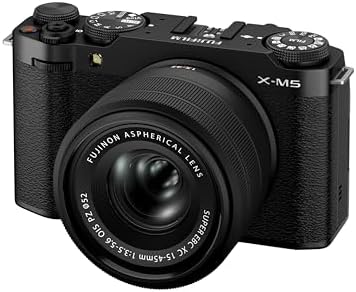
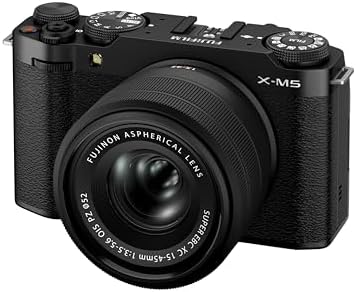
3. Fujifilm X-M5 - best compact system camera
Fujifilm X-M5 specifications
- Sensor: APS-C, 26.1 MP X-Trans CMOS 4
- Mount: Fujifilm X
- Weight with battery and card: 355 g
- Film simulation dial: Yes
- Maximum video: 6.2 K; 4K up to 60 fps
- Electronic viewfinder: No
- Screen: 3 inch vari-angle touchscreen
- Battery (CIPA): 330 shots
The Fujifilm X-M5 is the smallest and lightest interchangeable-lens camera here at 355 g with a battery and card. The Fujifilm X-M5 carries a 26.1 MP X-Trans CMOS 4 sensor, the highest resolution on this list, and a dedicated film simulation dial that switches between looks such as Classic Chrome, Classic Neg. and Acros black-and-white without opening a menu.
The dial is the reason beginners enjoy the Fujifilm X-M5: the camera produces finished, shareable JPEGs straight out of the body, so there is less pressure to learn editing software. Video is strong too, with 6.2K open-gate recording and 4K at up to 60p.
The Fujifilm X-M5 has no viewfinder, which makes bright sunlight and long telephoto shots harder, and Fujifilm rates the NP-W126S battery at 330 shots. The XC15-45mm kit is £899 on Amazon UK (September 2026), £100 more than the Sony Alpha 6400 kit.
Fujifilm X-M5 - pros and cons
Where to buy
Check price
4. Sony ZV-E10 II - best beginner camera for vlogging

Sony ZV-E10 II specifications
- Sensor: APS-C, 26 MP
- Mount: Sony E
- 4K video: up to 60 fps
- 10-bit 4:2:2 video: Yes
- Weight with battery and card: 377 g
- Electronic viewfinder: No
- Screen: 3 inch vari-angle touchscreen
- Battery (CIPA): 610 shots
The Sony ZV-E10 II is the best beginner camera for anyone who mainly films themselves. The Sony ZV-E10 II records 4K at up to 60p in 10-bit 4:2:2, the format that holds colour best when footage is graded, and its vari-angle screen flips forward so the presenter can check framing.
The biggest practical upgrade over the original ZV-E10 is the battery. The Sony ZV-E10 II uses the NP-FZ100 from Sony's full-frame cameras, rated at 610 shots, the highest figure on this list and roughly 2.4 times the Nikon Z50II rating. Product Showcase mode shifts focus from a face to an object held up to the lens, and the directional microphone includes a wind screen in the box.
The Sony ZV-E10 II has no viewfinder and no in-body stabilisation, so handheld walking shots rely on digital stabilisation, which crops the frame. The 16-50 mm kit costs £999 on Amazon UK (September 2026).
Sony ZV-E10 II - pros and cons
Where to buy
Check price
5. Nikon Z50II - best handling and viewfinder

Nikon Z50II specifications
- Sensor: APS-C, 20.9 MP
- Mount: Nikon Z
- Weight with battery and card: 550 g
- Continuous shooting: 11 fps
- 4K video: up to 60 fps (1.5x crop at 60p)
- Screen: 3.2 inch vari-angle touchscreen
- Battery (CIPA, screen): 250 shots
The Nikon Z50II suits beginners who want a camera that feels like a proper camera. The Nikon Z50II has the deepest handgrip here, a 3.2-inch vari-angle screen and an electronic viewfinder rated at up to 1,000 nits, which stays readable in bright sun. Its EXPEED 7 processor, the same family as Nikon's flagship Z9, drives subject detection across nine subject types.
The Nikon Z50II records 4K 30p oversampled from 5.6K across the full width, or 4K 60p with a 1.5x crop. The trade-offs are weight and stamina: the Nikon Z50II weighs 550 g with a battery and card, the heaviest on this list, and Nikon rates the EN-EL25a battery at 250 shots. The 16-50mm kit is listed at £799.99 on Amazon UK at the time of writing (September 2026).
Nikon Z50II - pros and cons
Where to buy
Check price
6. Sony ZV-1 II - best compact camera for beginners

Sony ZV-1 II specifications
- Sensor: 1-inch, 20.1 MP
- Lens: 18-50 mm equivalent, f/1.8-4
- Weight with battery and card: 292 g
- 4K video: up to 30 fps
- Screen: 3 inch vari-angle touchscreen
- Battery (CIPA): 290 shots
The Sony ZV-1 II is the pick for beginners who want better pictures than a phone but never want to buy or change a lens. The Sony ZV-1 II weighs 292 g, uses a 20.1 MP 1-inch-type sensor and has a built-in 18-50 mm equivalent zoom with an f/1.8 maximum aperture at the wide end, wide enough for arm's-length selfies and vlogs.
The limits are reach and battery. At 50 mm equivalent, the Sony ZV-1 II cannot zoom in on distant subjects the way the Canon EOS R50 twin-lens kit can, and Sony rates the NP-BX1 battery at 290 shots. At £659 on Amazon UK (September 2026), it is the cheapest camera on this list.
Sony ZV-1 II - pros and cons
Where to buy
Check price
Radar · 0-100 scores
- EOS R50
- Alpha 6400
- X-M5
- ZV-E10 II
Best camera for beginners UK 2026 spec sheet
| Spec | Canon EOS R50 | Sony Alpha 6400 | Fujifilm X-M5 | Sony ZV-E10 II | Nikon Z50II | Sony ZV-1 II |
|---|---|---|---|---|---|---|
| Sensor | APS-C | APS-C | APS-C | APS-C | APS-C | 1-inch |
| Resolution | 24.2 MP | 24.2 MP | 26.1 MP | 26 MP | 20.9 MP | 20.1 MP |
| Weight (with battery) | 375 g | 403 g | 355 g | 377 g | 550 g | 292 g |
| Burst | 15 fps | 11 fps | 8 fps | 11 fps | 11 fps | 24 fps |
| Max 4K frame rate | 30 fps | 30 fps | 60 fps | 60 fps | 60 fps | 30 fps |
| Viewfinder | Yes | Yes | No | No | Yes | No |
| Vari-angle screen | Yes | No | Yes | Yes | Yes | Yes |
| Battery (CIPA) | 440 shots | 410 shots | 330 shots | 610 shots | 250 shots | 290 shots |
How much does a second lens cost on each camera system?
A second lens costs between £139 and £189 on every mount in this guide, with Sony E-mount the cheapest. Compare Electronic's lens ecosystem cost table below prices the cheapest first-party fast prime for each mount on Amazon UK (September 2026), converts its focal length to the full-frame equivalent on that camera, and adds it to the kit price to show the real cost of a two-lens starter system.
| Mount (camera) | Cheapest fast prime | Lens price | Equivalent focal length | Kit price | Kit + prime |
|---|---|---|---|---|---|
| Canon RF (Canon EOS R50) | Canon RF 50mm F1.8 STM | £183.00 | 80 mm | £949.00 | £1,132.00 |
| Sony E (Sony Alpha 6400) | Sony FE 50mm F1.8 | £139.00 | 75 mm | £799.00 | £938.00 |
| Sony E (Sony ZV-E10 II) | Sony FE 50mm F1.8 | £139.00 | 75 mm | £999.00 | £1,138.00 |
| Nikon Z (Nikon Z50II) | Nikon NIKKOR Z 40mm f/2 | £189.00 | 60 mm | £799.99 | £988.99 |
| Fujifilm X (Fujifilm X-M5) | Fujifilm XC 35mm F2 | £164.99 | 53 mm | £899.00 | £1,063.99 |
The Canon EOS R50 kit price includes a second zoom, the RF-S 55-210mm.
Three findings stand out. The Sony Alpha 6400 builds the cheapest two-lens system at £938, because the Sony FE 50mm F1.8 is the cheapest first-party prime at £139. The Canon RF 50mm F1.8 STM frames as an 80 mm portrait lens on the Canon EOS R50 because of the 1.6x crop, which suits head-and-shoulders portraits but feels tight indoors. The Fujifilm XC 35mm F2 and Nikon NIKKOR Z 40mm f/2 land nearer a natural 50 to 60 mm view, the better all-round everyday focal length.
Third-party lenses widen the gap. Sony E and Fujifilm X have the largest ranges of third-party autofocus lenses from Sigma, Tamron, Viltrox and TTArtisan; Viltrox and TTArtisan sell autofocus primes for Nikon Z and Fujifilm X from around £129 on Amazon UK. Canon RF has fewer third-party APS-C autofocus options, so Canon EOS R50 owners should expect to buy mostly Canon glass.
Which beginner camera costs least per megapixel?
The Sony ZV-1 II costs least per megapixel at £32.79, followed closely by the Sony Alpha 6400 kit at £33.02. Compare Electronic's price-per-megapixel breakdown divides the Amazon UK kit price (September 2026) by the sensor resolution.
| Camera | Amazon UK price | Megapixels | Price per MP |
|---|---|---|---|
| Sony ZV-1 II | £659.00 | 20.1 | £32.79 |
| Sony Alpha 6400 (16-50mm kit) | £799.00 | 24.2 | £33.02 |
| Fujifilm X-M5 (XC15-45mm kit) | £899.00 | 26.1 | £34.44 |
| Nikon Z50II (16-50mm kit) | £799.99 | 20.9 | £38.28 |
| Sony ZV-E10 II (16-50mm kit) | £999.00 | 26.0 | £38.42 |
| Canon EOS R50 (twin-lens kit) | £949.00 | 24.2 | £39.21 |
Price per megapixel is a blunt measure, and the spread is narrow: only £6.42 separates cheapest and dearest. The Canon EOS R50 comes last because its kit includes a second zoom lens worth buying for sport and wildlife. The Sony ZV-1 II comes first on price but has a sensor about a third the area of the APS-C cameras, so the megapixels are smaller and noisier in low light. The useful takeaway is that the Fujifilm X-M5 delivers the most resolution for under £900.
Which lens should a beginner start with?
A beginner should start with the kit zoom and add one fast prime after a few months. The kit zooms on these cameras, such as the Canon RF-S 18-45mm and Sony 16-50mm, cover roughly 24 to 75 mm equivalent: wide enough for rooms and landscapes, long enough for casual portraits. They are small and stabilised, but their f/3.5 to f/6.3 apertures limit background blur and low-light speed.
A 50 mm f/1.8 prime lets in about four times the light of a kit zoom at f/3.5 at the same focal length, and nearly ten times the light at f/5.6. That difference means faster shutter speeds for children indoors and the blurred background most beginners buy a camera for. Buyers who shoot sport, wildlife or school events should add a telephoto zoom instead, which is why the Canon EOS R50 twin-lens kit is good value.
Which beginner camera is best for video?
The Sony ZV-E10 II is the best beginner camera for video, with 4K at up to 60p in 10-bit 4:2:2 and a battery rated at 610 shots. The rest of the list ranks as follows on video.
- Fujifilm X-M5:6.2K open gate and 4K 60p, plus film simulations that grade footage in camera. No viewfinder, so it films best from a tripod or at arm's length.
- Nikon Z50II:4K 30p oversampled from 5.6K, or 4K 60p with a 1.5x crop that narrows the kit zoom's wide end.
- Canon EOS R50: uncropped 4K 30p oversampled from 6K, with Dual Pixel autofocus that tracks faces reliably. No 4K 60p for smooth slow motion.
- Sony ZV-1 II: 4K 30p with a wide 18 mm equivalent lens, the simplest way to vlog handheld.
- Sony Alpha 6400: 4K 30p with a crop and a screen that flips upwards, where a top-mounted microphone blocks it.
What should UK buyers check before ordering a first camera?
UK buyers should check that the listing is UK stock, budget for a memory card and spare battery, and know their return rights.
- Warranty: Canon, Sony, Nikon and Fujifilm honour manufacturer warranties on UK-supplied stock. Grey imports sold by third-party sellers may carry no UK warranty, so check the seller before ordering.
- Returns: the Consumer Rights Act 2015 gives a 30-day right to reject faulty goods, and online orders carry a 14-day cancellation period under the Consumer Contracts Regulations.
- Spare battery: the Nikon Z50II (250 shots) and Sony ZV-1 II (290 shots) need a spare for a full day out; the Sony ZV-E10 II (610 shots) usually does not.
- Memory card: none of the kits includes an SD card. A V30-rated card is the minimum for 4K video.
Who should skip a beginner camera?
Buyers who mainly share to social media from a recent flagship phone should skip a beginner camera unless they need zoom or background blur. Buyers who already know they want to shoot fast sport or low-light events should consider a model with in-body stabilisation and a faster burst rate, such as the Canon EOS R7 or Fujifilm X-S20, rather than buying twice. Film-first creators should skip the Sony Alpha 6400 and the Canon EOS R50, which top out at 4K 30p.
Verdict
The Canon EOS R50 is the best camera for beginners in the UK in September 2026: dependable subject-detection autofocus, a viewfinder, uncropped 4K and a twin-lens kit that covers 29 to 336 mm equivalent for £949 on Amazon UK. The Sony Alpha 6400 builds the cheapest two-lens system at £938, the Fujifilm X-M5 is the lightest system camera at 355 g, the Sony ZV-E10 II is the vlogging pick, the Nikon Z50II handles best, and the Sony ZV-1 II is the pocket option. For the laptop to edit on, see Best laptop UK 2026.
Frequently asked questions
What is the best camera for beginners in the UK in 2026?
The Canon EOS R50 is the best camera for most beginners in the UK in 2026. The Canon EOS R50 pairs a 24.2 MP APS-C sensor with Dual Pixel autofocus, an electronic viewfinder, a vari-angle screen and uncropped 4K 30p video in a 375 g body. The twin-lens kit costs £949 on Amazon UK at the time of writing (September 2026) and covers wide-angle to telephoto.
Is a phone good enough instead of a beginner camera?
A phone is good enough for daylight snaps, but a beginner camera wins on zoom, background blur and low light. The Canon EOS R50 and Sony Alpha 6400 use APS-C sensors of around 330 to 370 mm², roughly five times the area of a typical 1/1.3-inch phone main sensor. That extra area gathers more light and makes shallow depth of field possible with a cheap prime lens.
Which beginner camera is best for vlogging?
The Sony ZV-E10 II is the best beginner camera for vlogging. The Sony ZV-E10 II records 4K at up to 60p in 10-bit 4:2:2, has a forward-facing vari-angle screen and uses the large NP-FZ100 battery, which Sony rates at 610 shots. The Sony ZV-1 II is the pocketable alternative, with a built-in 18-50 mm equivalent f/1.8-4 zoom.
What second lens should a beginner buy?
A fast standard prime is the best second lens for a beginner. The Canon RF 50mm F1.8 STM costs £183 on Amazon UK and the Sony FE 50mm F1.8 costs £139 (September 2026). An f/1.8 aperture lets in roughly four to five times more light than a kit zoom at f/3.5 to f/4, which blurs backgrounds for portraits and keeps shutter speeds up indoors.
Do beginner cameras have in-body image stabilisation?
None of the six picks has in-body image stabilisation. The Canon EOS R50, Sony Alpha 6400, Nikon Z50II, Fujifilm X-M5 and Sony ZV-E10 II rely on stabilised kit lenses or digital stabilisation for video. Buyers who want sensor-shift stabilisation need to step up to cameras such as the Fujifilm X-S20 or Canon EOS R7, which cost considerably more.
Is APS-C or full frame better for a beginner?
APS-C is the better starting point for most beginners. APS-C cameras such as the Canon EOS R50 and Fujifilm X-M5 weigh 355 to 375 g with a battery, cost less, and use smaller, cheaper lenses. Full frame gathers more light and suits low-light and professional work, but bodies and lenses cost roughly twice as much for a first camera.