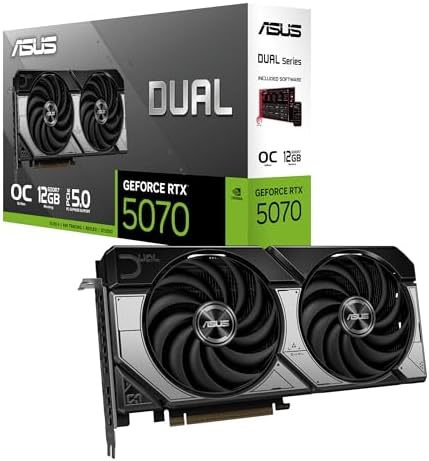


Is a GPU cooler worth it?
A premium graphics card cooler is worth extra when it measurably lowers noise or temperature. Compare power, case fit, independent tests and UK board prices.
On this page
At a glance
A premium graphics card cooler is worth paying for when it solves a real noise, temperature or case-fit problem. It is not worth a premium merely because a card has three fans or a metal shroud. The ASUS Dual RTX 5070 OC lists at £699.00 and ASUS Prime RTX 5080 OC at £1,437.13 on Amazon UK at the time of writing (November 2026), but the £738.13 gap compares different GPUs and cannot measure cooler value by itself.
| Board | Amazon UK price | Reference GPU power | What the comparison establishes |
|---|---|---|---|
| ASUS Dual RTX 5070 OC | £699.00 | 250W | Lower GPU power class |
| ASUS Prime RTX 5080 OC | £1,437.13 | 360W | Higher GPU power class |
| ASUS Dual RX 9060 XT 16GB | £619.99 | 160W | Different GPU, memory and power |
NVIDIA’s reference specification gives RTX 5070 a 250W board-power class and RTX 5080 360W; AMD lists 160W for RX 9060 XT. Higher power creates more heat to move, so a larger heatsink can be useful. Yet exact noise depends on the board, firmware, airflow and room. Find independent measurements of the precise model before paying for an assumed acoustic benefit.
Compare the NVIDIA GPU specifications, AMD RX 9060 XT specs, and named reviews that measure noise and temperature.
The radar uses representative GPU-tier results from Tom's Hardware's GPU hierarchy. Its native-resolution averages exclude upscaling and frame generation; they do not measure these partner boards' cooling or acoustics.
When does a premium cooler matter?
A stronger cooler matters in a warm room, compact case, quiet workstation or sustained GPU render where the fan runs for hours. It matters less in a well-ventilated tower with headphones and a short gaming session. The cooling system can only work with the air the case supplies, so blocked front intakes or dust filters can erase some benefit.
Review data should report the exact board name, test load, ambient temperature, fan mode and sound measurement. A lower temperature at a much louder fan speed is not necessarily a better cooler. Manufacturer descriptions such as “axial-tech” or “vapor chamber” explain hardware features, but do not substitute for a measured result.
There is also a size trade-off. The ASUS Prime RTX 5080 is listed as a 2.5-slot design. Check case clearance and neighbouring slots. Smaller cards can be the only sensible choice in a compact build, even if a longer triple-fan card has more heatsink area.
Does a premium cooler make a GPU faster?
Only if the cheaper card would otherwise hit a thermal limit. A larger heatsink can let the GPU maintain its target clock at a lower fan speed, but it cannot add shader units or memory bandwidth. Factory overclock settings and power limits also change the result. Compare sustained clocks from reviews rather than assuming that a more expensive board is faster.
Check the card’s length, slot thickness and connector clearance against the case manual. A bulky cooler can cover an M.2 or PCIe slot. A power cable bent sharply against the side panel can create fit problems even when the listed card length technically fits. Include PSU capacity: ASUS recommends 850W for the selected RTX 5080 board, while exact requirements vary by GPU and system.
Warranty is another practical distinction. The graphics processor may come from NVIDIA or AMD, but support is handled by the board maker. Check the UK warranty period, return route and whether cooler removal affects the terms. Keep the listing and invoice for the exact model.
How much should a quieter cooler cost?
Use a real price difference between the same GPU and comparable board variants; do not treat the RTX 5070-to-5080 price gap as cooler cost. At £699.00 versus £1,437.13, the £738.13 difference buys a much faster GPU tier, 4GB more GDDR7 memory and a different board. It says nothing isolated about fan noise.
For a cooler-only comparison, find two versions of the same GPU from one maker, then compare exact Amazon prices and independent measurements. Divide a verified same-GPU price premium by the intended years of ownership to put it in context. That calculation is meaningful only when independent testing confirms the exact cooler is quieter in the workload the buyer runs; fan count alone cannot establish that.
If the review evidence is absent, buy the lower-priced board with the required specs and good warranty. Use the remaining budget for case fans or a better case only after checking whether airflow is actually the problem.
Radar · 0-100 scores
- ASUS Dual GeForce RTX 5070 OC
- ASUS Prime GeForce RTX 5080 OC
- ASUS Dual Radeon RX 9060 XT 16GB
Raster and ray-tracing axes use representative GPU-tier averages from Tom's Hardware, not tests of these partner boards. Other axes use published specifications.
Who should pay for a premium cooler?
Pay more when independent tests show a quieter exact card, it fits the case and the workload makes noise noticeable. Skip the premium when it crowds out a better GPU tier, the build is already quiet, or the case cannot fit the larger heatsink. The 250W RTX 5070 and 360W RTX 5080 have different cooling demands, but their price gap cannot be assigned to cooler quality.
For related advice, read best graphics cards UK, RTX 5070 versus RTX 5080 and what graphics card suits 1440p?. Our recommendation is based on published specifications and independent measurements, not hands-on cooler tests.
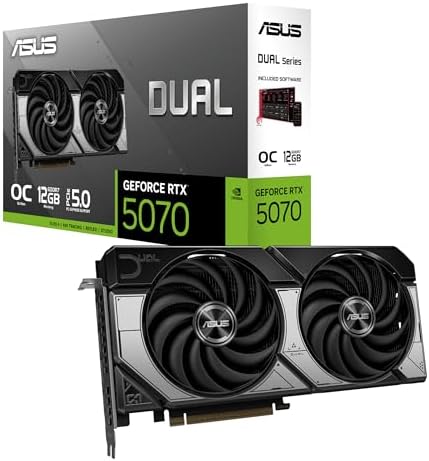
ASUS Dual GeForce RTX 5070 OC key specifications
- Memory: 12GB GDDR7
- Board power: 250W
- Recommended PSU: 650W
- Design: ASUS Dual dual-fan
ASUS Dual GeForce RTX 5070 OC cooler trade-off
Where to buy
Check price

ASUS Prime GeForce RTX 5080 OC key specifications
- Memory: 16GB GDDR7
- Board power: 360W
- Recommended PSU: 850W
- Design: ASUS Prime 2.5-slot
ASUS Prime GeForce RTX 5080 OC cooler trade-off
Where to buy
Check price
What is the verdict?
Pay for a premium cooler when measured noise or sustained temperatures justify it on the same GPU. Check exact board dimensions first. The RTX 5070 and RTX 5080 prices compare different GPU tiers and cannot isolate cooler value.
Frequently asked questions
Does a premium graphics card cooler improve performance?
A larger cooler can help a card hold its intended clocks when temperatures would otherwise limit it, but it does not add compute units or memory bandwidth. Compare exact board reviews that measure sustained clock, temperature and noise. Cooler design, fan curve, case airflow, room temperature and board power all affect the result.
Is a triple-fan GPU quieter than a dual-fan GPU?
Not automatically. Fan diameter, speed, heatsink area, board power and firmware all affect noise. A triple-fan model can move the same air at lower speed, but only an independent review of the exact card can establish its sound level. Check the test distance, room noise and workload before comparing decibel figures.
Should I pay extra for a GPU cooler?
Pay extra when a named independent review shows lower noise or temperature that matters in the buyer’s case, and the card fits. A larger cooler is less useful when headphones hide fan sound, the case already has strong airflow, or the extra spend would force a lower GPU tier. Check the same board’s price and warranty.
How much space does a graphics card cooler need?
Check the card’s length, thickness in slots and width including the power connector against the case manual. Thick coolers can cover neighbouring expansion slots, and a side panel can press on a cable. ASUS lists dimensions for each partner board. A model that does not fit is not worth a discount.
Do GPU coolers affect warranty?
The manufacturer warranty applies to the exact board and region, not just the GPU chip. Read the card maker’s UK terms before removing a cooler or changing thermal pads, since damage and unauthorised modification can affect support. Keep the invoice and record the model and serial number.
Is the RTX 5080 cooler worth more than RTX 5070?
The ASUS Prime RTX 5080 OC uses a larger 2.5-slot cooler and has a higher board power class than ASUS Dual RTX 5070 OC. The observed Amazon price difference is £738.13, mostly paying for a different GPU tier rather than a cooler alone. Compare board dimensions and measured thermal results before attributing the premium to cooling.