

Is 144Hz worth it on a TV?
Not for consoles: PS5 and Xbox Series X stop at 120 Hz. A gaming PC can use 144 Hz. Input lag, VRR, the £96 price gap and the best value gaming TVs.
On this page
Not for a console: the PS5 and Xbox Series X output at up to 120 Hz, so a 144 Hz gaming TV only pays off with a gaming PC that renders above 120 fps at 4K. A 144 Hz panel is now cheap enough to buy anyway, and the gap over a 60 Hz TV is £96.00 at 55 inches on Amazon UK at the time of writing (October 2026). The wider console shortlist is in Best TV for PS5 and Xbox Series X.
| Situation | 144 Hz TV needed? | Pick | Price |
|---|---|---|---|
| PS5 or Xbox Series X | No, consoles stop at 120 Hz | Hisense 55E78QTUK PRO | £445.00 |
| Gaming PC at 4K above 120 fps | Yes | TCL 55C6K | £529.99 |
| PC on a desk, OLED | Yes, with VRR to 165 Hz | LG OLED42C65LA | £999.00 |
| PC on a large screen | Yes, up to 165 Hz | Hisense 65U8QTUK | £1,099.00 |
| Films and story games at 60 fps | No | TCL 55V6D | £349.00 |
What does a 144Hz TV add over 120Hz?
It adds 24 Hz of headroom, which is 1.39 ms per frame, and only a PC can use it. Microsoft lists the Xbox Series X at up to 120 FPS, with one HDMI 2.1 port, variable refresh rate and auto low latency mode. Sony's PS5 support pages cap video at 4K 120 Hz, as Do I need a 120Hz TV for PS5? sets out.
Compare Electronic worked out the time each refresh rate takes to draw one frame, and the pixel data a 4K 10-bit signal needs:
- 60 Hz draws a frame every 16.67 ms; 120 Hz every 8.33 ms; 144 Hz every 6.94 ms; 165 Hz every 6.06 ms.
- Moving from 120 Hz to 144 Hz saves 1.39 ms per frame; from 144 Hz to 165 Hz saves a further 0.88 ms.
- 4K at 10-bit colour needs 29.86 Gbps of pixel data at 120 Hz, 35.83 Gbps at 144 Hz and 41.06 Gbps at 165 Hz, before blanking and encoding overhead. HDMI 2.1 carries up to 48 Gbps, so 165 Hz sits close to the limit of the link.
Refresh rate is not the only factor. LG lists the OLED42C65LA as a 120 Hz panel with VRR up to 165 Hz, so the number on the box can mean the panel or the variable refresh range.
Which gaming TVs have low input lag?
Most current 4K TVs from Hisense, TCL, LG and Sony have a game mode that RTINGS rates as low lag, and ALLM switches it on automatically. RTINGS says the Hisense U7N "has low input lag, so you get a snappy gaming experience, especially at 120Hz", and notes support for 4K at 144 Hz over HDMI 2.1. It rates the Sony BRAVIA 5 as having low input lag and the Sony BRAVIA 7 II as having very low input lag.
Two cautions apply. RTINGS keeps exact millisecond figures behind its membership, and the Hisense U7N is a different TV from the Hisense 55E78QTUK PRO. For the PRO, Hisense's Amazon UK listing describes "144Hz VRR and ultra low input lag" through AMD FreeSync Premium PRO, which is a maker claim. Response time matters as well: RTINGS calls the BRAVIA 5 and BRAVIA 7 II slow in pixel transitions, which blurs fast motion even when lag is low. The Sony pair is compared in Sony BRAVIA 5 vs BRAVIA 7 II.
How much does a 144Hz gaming TV cost?
A 144 Hz 55-inch TV costs £96.00 to £180.99 more than the 60 Hz TCL 55V6D at £349.00, a premium of 27.5% to 51.9%. The Mini LED step in the TCL 55C6K accounts for most of the larger gap.
| Step | From | Price | To | Price | Gap | Premium |
|---|---|---|---|---|---|---|
| 60 Hz to 144 Hz, QLED | TCL 55V6D | £349.00 | Hisense 55E78QTUK PRO | £445.00 | £96.00 | 27.5% |
| 60 Hz to 144 Hz, Mini LED | TCL 55V6D | £349.00 | TCL 55C6K | £529.99 | £180.99 | 51.9% |
| 144 Hz QLED to 144 Hz Mini LED | Hisense 55E78QTUK PRO | £445.00 | TCL 55C6K | £529.99 | £84.99 | 19.1% |
Over a seven-year life the £96.00 gap is £13.71 a year. Buyers sizing a screen can use What size TV do I need?.
Are 4K gaming projectors a low input lag option?
A gaming projector can match a TV for lag but costs far more per inch of dark-room picture. BenQ lists the X3100i with a 4 ms response time and 4.2 ms at 1080p 240 Hz on its Amazon UK listing, at £1,975.00 at the time of writing (October 2026), and the trade-offs against a screen are in Is a projector better than a TV?.
Which 144Hz gaming TV should you buy?
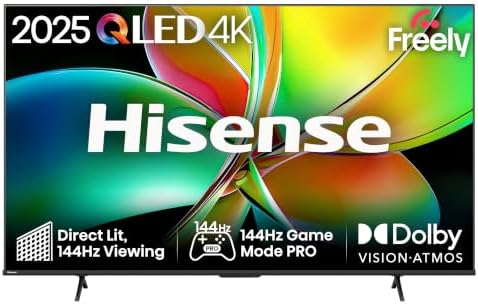
The Hisense 55E78QTUK PRO is the best value 144 Hz gaming TV, at £445.00 on Amazon UK at the time of writing (October 2026). Hisense lists a 144 Hz panel, VRR through AMD FreeSync Premium PRO and a game mode that starts through ALLM.

Hisense 55E78QTUK PRO specifications (Hisense)
- Panel: 55-inch 4K QLED, direct lit full array
- Refresh rate: 144 Hz with 144Hz Game Mode PRO
- Gaming: VRR, ALLM, AMD FreeSync Premium PRO
- HDMI 2.1: two ports
- HDR: Dolby Vision and HDR10+
- Audio: Dolby Atmos
It suits console and PC players who want 144 Hz without paying for a Mini LED backlight. The compromises are a direct-lit QLED panel instead of local dimming zones and two HDMI 2.1 ports, which limits a multi-console setup.
Hisense 55E78QTUK PRO - pros and cons
Where to buy
Check price
Three alternatives cover a better backlight, a desk OLED and a large-screen flagship, at Amazon UK prices in October 2026.
Also consider
Radar · 0-100 scores
- 55E78QTUK PRO 55" QLED
- 55C6K 55" QD-Mini LED
- OLED evo C6 42" (OLED42C65LA)
- 65U8QTUK 65" Mini-LED
Verdict
A 144 Hz TV is a PC feature: consoles stop at 120 Hz, so only players with a graphics card that clears 120 fps at 4K gain from it. The Hisense 55E78QTUK PRO at £445.00 is the value pick, and the TCL 55C6K at £529.99 suits brighter rooms. The wider field is in Best TV for PS5 and Xbox Series X.
Frequently asked questions
Do I need a 144Hz TV for gaming?
Only for a gaming PC. The PS5 and Xbox Series X output at up to 120 Hz, so a 144 Hz TV runs a console at 120 Hz. A PC with a graphics card that renders above 120 fps at 4K can use the extra 24 Hz. The Hisense 55E78QTUK PRO costs £445.00 on Amazon UK at the time of writing (October 2026).
Is a 144Hz TV better than a 120Hz TV?
Slightly, and only on a PC. A 144 Hz screen draws a frame every 6.94 ms against 8.33 ms at 120 Hz, a gap of 1.39 ms per frame. Consoles cannot send more than 120 Hz, so the difference vanishes there. For films and streaming the two are identical, because content runs at 24, 30 or 60 frames per second.
What is a good input lag for a gaming TV?
RTINGS rates the Sony BRAVIA 7 II as having very low input lag and the Sony BRAVIA 5 as having low input lag, and says the Hisense U7N has low input lag especially at 120 Hz. RTINGS keeps exact millisecond figures for members, so the useful rule is to pick a TV with a game mode that switches on automatically through ALLM.
Do the PS5 and Xbox Series X support 144Hz?
No. Microsoft lists the Xbox Series X at up to 120 FPS with one HDMI 2.1 port, variable refresh rate and auto low latency mode. Sony's PS5 support pages cap video output at 4K 120 Hz. Neither console sends 144 Hz, so a 144 Hz TV is a PC feature that consoles happen to share.
What is the best value gaming TV?
The Hisense 55E78QTUK PRO, at £445.00 on Amazon UK at the time of writing (October 2026). Hisense lists 144 Hz, variable refresh rate through AMD FreeSync Premium Pro and a game mode that switches on through ALLM. The TCL 55C6K at £529.99 adds a Mini LED backlight, and the TCL 55V6D at £349.00 is the 60 Hz alternative.
Are 4K gaming projectors worth it for low input lag?
For a dedicated room, yes. The BenQ X3100i lists a 4 ms response time and 4.2 ms at 1080p 240 Hz on Amazon UK, at £1,975.00 at the time of writing (October 2026). That is more than three times the price of the Hisense 55E78QTUK PRO, and a projector needs a dark room and a 100 inch wall.