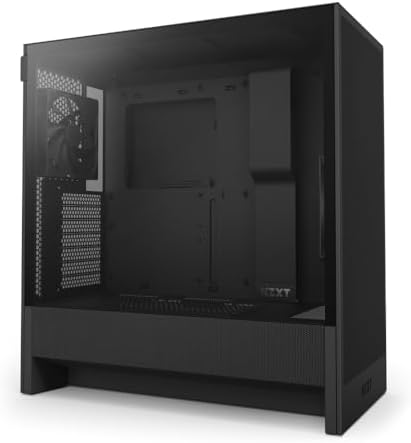


Case sizes, decoded
PC case sizes explained: how E-ATX, ATX, Micro ATX and Mini ITX boards map to full tower, mid tower and SFF cases, with litres, GPU clearance and UK prices.
On this page
At a glance
PC case sizes follow the motherboard inside them: E-ATX and ATX boards go in full tower and mid tower cases, Micro ATX boards in micro ATX cases, and Mini ITX boards in small form factor (SFF) cases. Most buyers need a mid tower, which takes an ATX board measuring 305 x 244 mm, a standard ATX power supply and a 360 mm radiator in 45 to 62 litres.
Compare Electronic's size comparison table below names one current case per size, with its volume, graphics card and cooler limits and Amazon UK price on 5 October 2026. Specs come from the manufacturer spec pages; where a maker publishes dimensions but no volume, the litres are calculated from those dimensions.
What are the motherboard sizes: E-ATX, ATX, Micro ATX and Mini ITX?
ATX measures 305 x 244 mm, Micro ATX 244 x 244 mm and Mini ITX 170 x 170 mm; E-ATX reaches 305 x 330 mm but has no single standard. Intel published ATX in 1995 and Micro ATX in 1997, and VIA Technologies created Mini ITX in 2001. The full 305 x 330 mm size matches SSI EEB, a server board standard.
| Form factor | Board size | Max slots | Origin | Case sizes it fits |
|---|---|---|---|---|
| E-ATX | Up to 305 x 330 mm (varies by maker) | 7 | No single standard; the largest match SSI EEB | Full tower, larger mid towers |
| ATX | 305 x 244 mm | 7 | Intel, 1995 | Mid tower, full tower |
| Micro ATX | 244 x 244 mm | 4 | Intel, 1997 | Micro ATX, mid tower |
| Mini ITX | 170 x 170 mm | 1 | VIA Technologies, 2001 | Mini ITX (SFF) and every larger case |
The smaller boards are cut-down ATX: a Micro ATX board is an ATX board 61 mm shorter, and its mounting holes line up with ATX, so a Micro ATX or Mini ITX board fits in any ATX case. The reverse never works. Expansion slots are the practical cost of a smaller board: a Mini ITX board has one slot, and the graphics card fills it.
Most consumer E-ATX boards are narrower than 330 mm, so case makers quote a width rather than a name. NZXT and Phanteks support E-ATX up to 277 mm wide, Corsair lists 305 x 277 mm for the 3500X, and Lian Li allows 280 mm for E-ATX and 330 mm for SSI EEB in the Lancool 217. Board picks are ranked in Best motherboard for gaming UK 2026.
How big is each PC case size in litres?
In Compare Electronic's examples, a full tower measures about 79 litres, mid towers 45 to 62 litres, micro ATX cases 26 to 35 litres and mini ITX cases 18 to 21 litres. NZXT's own range shows the spread inside one brand: the H2 Flow mini ITX case is 20.7 litres, the H3 Flow micro ATX case 35 litres, the H5 Flow 45.0 litres, the H7 Flow 62.1 litres and the dual-chamber H9 Flow 76.7 litres.
| Case size | Boards | Volume | Example cases |
|---|---|---|---|
| Full tower | E-ATX, ATX, Micro ATX, Mini ITX | About 79 litres | Phanteks NV7 D-RGB 78.9 L |
| Mid tower | ATX, Micro ATX, Mini ITX; often E-ATX to 277 or 280 mm | 45 to 62 litres | NZXT H5 Flow 45.0 L, MSI MAG Forge 320R Airflow 49.4 L, Corsair 3500X 55.9 L, Lian Li Lancool 217 57.7 L, NZXT H7 Flow 62.1 L |
| Micro ATX | Micro ATX, Mini ITX | 26 to 35 litres | Lian Li A3-mATX 26.3 L, NZXT H3 Flow 35 L |
| Mini ITX (SFF) | Mini ITX | 18 to 21 litres | Cooler Master NR200P V3 18.62 L, NZXT H2 Flow 20.7 L |
Volume is height x width x depth: a litre is 1,000,000 cubic millimetres, so the Lian Li Lancool 217 at 482 x 238 x 503 mm is about 57.7 litres. The labels overlap, because each manufacturer names its own cases. NZXT sells the 76.7-litre H9 Flow as an ATX case, only 2.2 litres short of the Phanteks NV7 D-RGB full tower, so the litres and clearance figures matter more than the name.
PC case size comparison: what fits in each size?
Smaller cases fit bigger graphics cards than their size suggests: the 26.3-litre Lian Li A3-mATX takes a 415 mm card, 35 mm longer than the 57.7-litre Lian Li Lancool 217 mid tower. Compare Electronic's table names one case per size and sets its volume against the Phanteks NV7 D-RGB full tower.
| Size | Example case | Volume | Share of full tower | Max GPU | Max CPU cooler | Power supply | Price |
|---|---|---|---|---|---|---|---|
| Full tower | Phanteks NV7 D-RGB | 78.9 L* | 100% | 450 mm | 185 mm | ATX, to 255 mm | £159.95 |
| Mid tower | Lian Li Lancool 217 | 57.7 L* | 73% | 380 mm | 180 mm | ATX, to 220 mm | £109.99 |
| Compact mid tower | NZXT H5 Flow | 45.0 L | 57% | 410 mm | 170 mm | ATX, to 200 mm | £49.95 |
| Micro ATX | Lian Li A3-mATX | 26.3 L | 33% | 415 mm | 165 mm | ATX, SFX or SFX-L, to 220 mm | £73.99 |
| Mini ITX | Cooler Master NR200P V3 | 18.62 L | 24% | 361.5 mm | 70 mm | SFX or SFX-L | £169.89 |
The pattern holds across the rows: shrinking the case costs CPU cooler height and power supply choice first, and graphics card length last. The Cooler Master NR200P V3 takes 24% of the Phanteks NV7 D-RGB's volume but fits a card 80% as long. Price does not follow size either. The smallest case here costs £9.94 more than the full tower, because Cooler Master adds CNC-machined aluminium side panels and a PCIe 5.0 riser cable.
What size PC case do most people need?
A mid tower. It takes every common board up to ATX, a standard ATX power supply, a 360 mm radiator and graphics cards of 380 mm or more, and it includes the cheapest cases in this guide: the NZXT H5 Flow costs £49.95 on Amazon UK at the time of writing (October 2026).
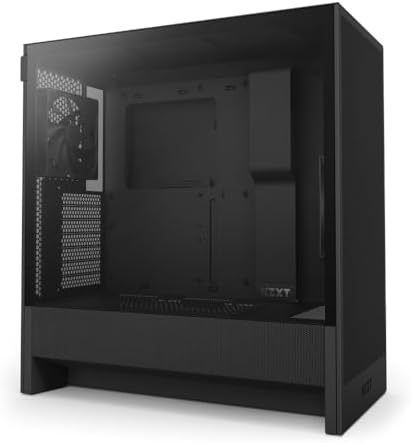
NZXT H5 Flow specifications (NZXT)
- Format: mid tower, 465 x 225 x 430 mm (H x W x D), 45.0 litres, 7.28 kg
- Motherboards: E-ATX (up to 277 mm), ATX, Micro ATX, Mini ITX; no back-connect support
- Clearance: GPU 410 mm, CPU cooler 170 mm, ATX PSU 200 mm
- Radiators: 360 mm front, 240 mm top
- Fans: 2 x F120Q included (front and rear); 8 mounts in total
- Front I/O: 1 x USB 3.2 Type-A, 1 x USB 3.2 Gen 2x2 Type-C (20 Gbps), headset jack
- Warranty: 2 years
The NZXT H5 Flow is the smallest mid tower in this guide at 45.0 litres, by NZXT's figure, yet it takes E-ATX boards up to 277 mm wide, a 410 mm graphics card, a 170 mm CPU cooler and a 200 mm ATX power supply. Ultra-fine mesh covers the front, top and side, two F120Q fans come fitted, and the front USB-C port runs at 20 Gbps.
The Lian Li Lancool 217 at £109.99 is the better mid tower for buyers who can spend more, with five fans, back-connect support and a 180 mm cooler limit. It is the top pick in Best PC case UK 2026, and every mid tower is ranked in Best mid tower PC case UK 2026.
NZXT H5 Flow - pros and cons
Where to buy
Check price
Radar · 0-100 scores
- H5 Flow (2024, black)
- Phanteks NV7 D-RGB (black)
- Lian Li A3-mATX Wood Edition (black)
- Cooler Master NR200P V3
Full tower vs mid tower: which should you buy?
Buy a mid tower unless the build needs more than one large radiator, a wide E-ATX workstation board or a graphics card longer than 425 mm, the largest mid tower limit in this guide (Corsair 3500X). The Phanteks NV7 D-RGB full tower stands 586 mm tall against 503 mm for the Lian Li Lancool 217, weighs 16.90 kg and fits three 360 mm radiators at once, a 450 mm card and a 185 mm cooler. The Lancool 217 fits one 360 mm radiator, on top.
The extra space mainly serves custom water cooling, with a pump, a reservoir and several radiators, plus eight expansion slots on the NV7 against seven on the Lancool 217. For a single graphics card and an air cooler or 360 mm all-in-one cooler, a mid tower fits everything in 21 litres less space. Full towers are ranked in Best full tower PC case UK 2026.
ATX vs Micro ATX case: which is better?
An ATX case is better for most builds because it takes both board sizes and every ATX power supply; a micro ATX case is better for a desk PC that should take up half the space. A Micro ATX board is 244 x 244 mm, 61 mm shorter than ATX, with four expansion slots against seven. A single graphics card occupies two to four slot positions, from the 2-slot RTX 5090 Founders Edition to the 3.8-slot ASUS ROG Astral RTX 5090, so a one-card build loses little.
The Lian Li A3-mATX shows how capable micro ATX cases have become: 26.3 litres, less than half the 57.7 litres of the Lancool 217, with a 415 mm graphics card limit, a 360 mm radiator on the top or side and room for an ATX power supply up to 220 mm, for £73.99. The cost is a 165 mm cooler limit and Micro ATX and Mini ITX boards only. The ranking is in Best micro ATX case UK 2026.
Micro ATX vs Mini ITX case: what is the difference?
A mini ITX case saves space but gives up air cooling, power supply choice and expansion slots: the mini ITX example here is 29% smaller than the micro ATX example. A Mini ITX board measures 170 x 170 mm and has one expansion slot. The Cooler Master NR200P V3 fits that board, a vertical 361.5 mm graphics card on a PCIe 5.0 riser and a 280 mm liquid cooler in 18.62 litres, but its air cooler limit is 70 mm and it needs an SFX or SFX-L power supply.
The Lian Li A3-mATX, 7.7 litres bigger at 26.3 litres, takes a 165 mm tower cooler and a standard ATX power supply for £95.90 less. Buyers who want the smallest PC that still runs a high-end graphics card should buy mini ITX; everyone else saves money with micro ATX. The full ranking is in Best mini ITX case UK 2026.
How does case size affect GPU and radiator clearance?
Case size limits radiators and coolers far more than graphics card length. Radiator support shrinks with volume: the Phanteks NV7 D-RGB takes three 360 mm radiators, the Lian Li Lancool 217 one 360 mm on top, the Lian Li A3-mATX a 360 mm on the top or side, and the Cooler Master NR200P V3 one 280 mm on top.
Graphics cards fit almost everywhere. NVIDIA lists the RTX 5090 Founders Edition at 304 mm long and two slots thick, which fits every case here. ASUS lists the ROG Astral RTX 5090 at 357.6 mm long and 3.8 slots thick, which still fits all five, including the NR200P V3 with 3.9 mm to spare. Front radiators eat into that length: NZXT says its H3 Flow fits a 377 mm card with no front fans but 317 mm with a front radiator and fans, a loss of 60 mm.
CPU cooler limits fall from 185 mm in the full tower to 165 mm in the micro ATX case and 70 mm in the mini ITX case, so an air cooler taller than 165 mm needs a mid tower or full tower. Cards and their lengths are compared in Best graphics card UK 2026.
SFX vs ATX power supply: which does a small case need?
The mini ITX case here needs an SFX power supply; every larger case takes a standard ATX unit, and the Lian Li A3-mATX takes both. Intel's design guides put an ATX power supply at 150 x 86 x 140 mm and an SFX unit at 125 x 63.5 x 100 mm, about 44% of the volume. SFX-L, which Corsair describes as SFX with extra depth for a 120 mm fan, measures 125 x 63.5 x 130 mm. SFX units carry the same main connectors as ATX units, so the choice comes down to size.
ATX depth varies from 140 mm to 230 mm, so check the case's power supply length limit: 200 mm in the NZXT H5 Flow, 220 mm in the Lian Li Lancool 217 and A3-mATX, and 255 mm in the Phanteks NV7 D-RGB. Custom cables for both formats are compared in Best sleeved PSU cables UK 2026.
Which PC case size should you buy?
Buy the smallest case that fits the motherboard, graphics card and cooler on the parts list, with a mid tower as the default.
- A first-time builder with an ATX board and one graphics card: a mid tower. The NZXT H5 Flow costs £49.95 and the Lian Li Lancool 217 £109.99.
- A builder planning custom water cooling or an E-ATX workstation board: a full tower such as the Phanteks NV7 D-RGB at £159.95.
- A gamer short on desk space who still wants an ATX power supply and a tower cooler: a micro ATX case such as the Lian Li A3-mATX at £73.99.
- A buyer who wants a console-sized PC for a living room or a LAN bag: a mini ITX case such as the Cooler Master NR200P V3 at £169.89, with an SFX power supply and a 240 mm or 280 mm liquid cooler.
Verdict
PC case size follows the motherboard: E-ATX and ATX boards need a mid tower or full tower, Micro ATX boards fit 26 to 35-litre micro ATX cases, and Mini ITX boards fit 18 to 21-litre SFF cases. A mid tower is right for most builds: the NZXT H5 Flow at £49.95 is the compact choice at 45.0 litres, and the Lian Li Lancool 217 at £109.99 is the best PC case overall. Go bigger with the Phanteks NV7 D-RGB (£159.95) only for multiple radiators, and smaller with the Lian Li A3-mATX (£73.99) or Cooler Master NR200P V3 (£169.89) when desk space matters more than cooler choice.
Frequently asked questions
What are the different PC case sizes?
The four common PC case sizes are full tower, mid tower, micro ATX and mini ITX, also called small form factor. In Compare Electronic's examples, the Phanteks NV7 D-RGB full tower measures about 78.9 litres, mid towers measure 45 to 62 litres, the Lian Li A3-mATX measures 26.3 litres and the Cooler Master NR200P V3 mini ITX case measures 18.62 litres.
What is the difference between a full tower and a mid tower?
A full tower is taller and deeper, with more radiator mounts, fan mounts and drive bays. The Phanteks NV7 D-RGB full tower stands 586 mm tall and fits three 360 mm radiators, a 450 mm graphics card and E-ATX boards. The Lian Li Lancool 217 mid tower stands 503 mm tall and fits a 380 mm card and one 360 mm radiator. Both take ATX boards.
Can an ATX motherboard fit in a micro ATX case?
No. An ATX motherboard measures 305 x 244 mm and a Micro ATX board 244 x 244 mm, so an ATX board is 61 mm too long for a case built around Micro ATX, such as the Lian Li A3-mATX. It works the other way round: a Micro ATX or Mini ITX board fits in an ATX mid tower, because the mounting holes line up.
Micro ATX vs Mini ITX: which case should you buy?
Buy a micro ATX case for cheaper parts and easier cooling, and a mini ITX case for the smallest possible PC. The Lian Li A3-mATX costs £73.99 for 26.3 litres, a 165 mm air cooler and a standard ATX power supply. The Cooler Master NR200P V3 costs £169.89 for 18.62 litres but needs an SFX power supply and limits air coolers to 70 mm.
Do small PC cases fit big graphics cards?
Many do. The 26.3-litre Lian Li A3-mATX fits a 415 mm graphics card, 35 mm longer than the limit of the 57.7-litre Lian Li Lancool 217 mid tower, and the 18.62-litre Cooler Master NR200P V3 fits a 361.5 mm, 3.8-slot card. Small cases give up CPU cooler height, radiator mounts and power supply size before they give up graphics card length.
What is the difference between an SFX and an ATX power supply?
Size. Intel's design guides put a standard ATX power supply at 150 x 86 x 140 mm and an SFX unit at 125 x 63.5 x 100 mm, about 44% of the volume. SFX-L stretches the depth to 130 mm for a 120 mm fan. The Cooler Master NR200P V3 needs SFX or SFX-L, while the Lian Li A3-mATX accepts ATX, SFX or SFX-L.
Is E-ATX the same size as SSI EEB?
Not exactly. SSI EEB is a server standard measuring 305 x 330 mm, and the largest E-ATX boards share that size, but E-ATX has no single standard and most consumer E-ATX boards are narrower. Case makers quote a maximum width instead: 277 mm for the NZXT H5 Flow and Phanteks NV7 D-RGB, and 280 mm for E-ATX or 330 mm for SSI EEB in the Lian Li Lancool 217.
What size PC case do most people need?
A mid tower suits most people. It takes ATX, Micro ATX and Mini ITX boards, a standard ATX power supply, a 360 mm radiator and graphics cards of 380 mm or more. The NZXT H5 Flow costs £49.95 for 45.0 litres, and the Lian Li Lancool 217, Compare Electronic's best PC case overall, costs £109.99 on Amazon UK at the time of writing (October 2026).