
The best indoor TV aerials
The best indoor TV aerial in the UK for 2026: One For All SV9215, SV9385 and SV9015 and August DTA240B, with transmitter distance and amplified vs passive.
On this page
At a glance
The best indoor TV aerial in the UK for most homes in 2026 is the One For All SV9215. The One For All SV9215 is a 4 mm thick amplified flat aerial with up to 41 dB of gain, a 3G/4G/5G filter and a 15-mile rated range, and it cost £31.95 on Amazon UK at the time of writing (September 2026). The One For All SV9385 adds more gain for weaker signals, the August DTA240B is the cheapest portable pick at £12.95, and the One For All SV9015 is the right choice for homes within 3 miles of a transmitter.
An indoor aerial succeeds or fails on one number: the distance to the Freeview transmitter. This guide explains how to find that transmitter, how much signal every extra mile and every wall costs, when an amplifier helps and when it hurts, and when a smart TV with Freely needs no aerial at all.
What is the best indoor TV aerial for Freeview?
The One For All SV9215 is the best indoor TV aerial for Freeview within 15 miles of a main transmitter. Every Freeview aerial must cover the UHF band from 470 MHz to 694 MHz, where UK digital TV has sat since the 700 MHz band was cleared for mobile data in 2020. Any aerial sold as "Freeview" covers that band; the differences are gain, filtering and cable length.
- Within 3 miles: a passive aerial such as the One For All SV9015 or August DTA240B.
- 3 to 15 miles: an amplified aerial with a 5G filter, such as the One For All SV9215 or SV9385.
- Beyond 15 miles or behind a hill: a loft or rooftop aerial, or Freely over broadband.
Marketplace listings that promise 300 to 880 miles of range are physically impossible: the curvature of the Earth limits a transmitter's line of sight to tens of miles. This guide includes only aerials from established brands with realistic ratings.
1. One For All SV9215 - best indoor TV aerial
One For All SV9215 specifications
- Type: amplified flat indoor aerial
- Amplifier gain: up to 41 dB
- Rated range: 15 miles
- Mobile filter: 3G/4G/5G
- Cable: 3 m
- Thickness: 4 mm
- Power: from the TV or included mains adaptor
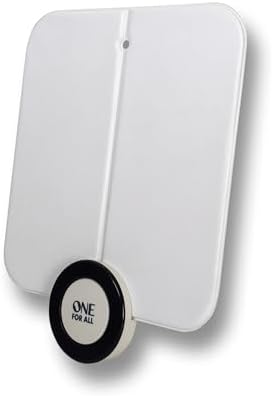
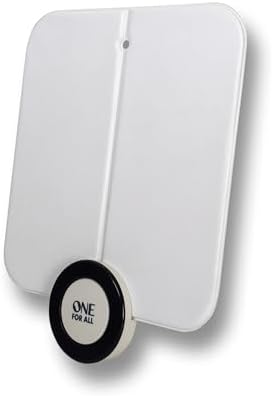
The One For All SV9215 is the best indoor TV aerial for most UK homes in September 2026. One For All rates the SV9215 for Freeview reception up to 15 miles from a transmitter, and its built-in amplifier adds up to 41 dB. The 3G/4G/5G filter blocks mobile signals just above the Freeview band, the most common cause of pixelation near a phone mast.
The One For All SV9215 is 4 mm thick, so it sticks to a wall or window, or hides behind a flat TV. One For All supplies a 3 m cable and a mains adaptor, and the SV9215 can also take power from a TV or set-top box that supplies 5 V through the aerial socket. For a window mount facing the transmitter, the SV9215 is the most practical aerial here.
One For All SV9215 - pros and cons
Where to buy
Check price
2. One For All SV9385 - most gain

One For All SV9385 specifications
- Type: amplified indoor aerial
- Amplifier gain: up to 47 dB
- Rated range: 15 miles
- Mobile filter: 3G/4G/5G
- Cable: 1.5 m
- DAB+ radio: Yes
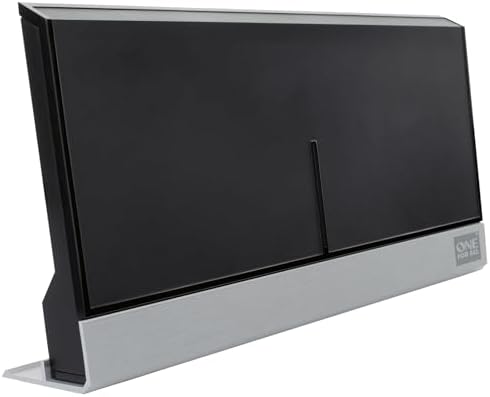
The One For All SV9385 is the pick for homes toward the edge of indoor reception, at £23.25 on Amazon UK at the time of writing (September 2026). UK retailer spec sheets list up to 47 dB of amplification, 6 dB more than the SV9215, with the same 15-mile rating and 3G/4G/5G block filter. The SV9385 also receives DAB+ radio.
The One For All SV9385 is a free-standing aerial with a 1.5 m cable, half the length of the SV9215's, so it must sit next to the TV. That is its main weakness: the best spot for indoor reception is usually a window facing the transmitter, not the TV stand.
One For All SV9385 - pros and cons
Where to buy
Check price
3. August DTA240B - cheapest portable aerial

August DTA240B specifications
- Type: passive portable aerial
- Antenna gain: 3 dBi
- Amplified: No
- Cable: 1.5 m
- Mount: magnetic base
The August DTA240B is the cheapest indoor aerial worth buying at £12.95 on Amazon UK at the time of writing (September 2026). August rates the DTA240 at 3 dBi of antenna gain from a short whip on a magnetic base, which sticks to a caravan roof, a window frame or a metal shelf.
The August DTA240B has no amplifier and a 1.5 m cable, so it suits strong-signal areas, a caravan pitch in sight of a transmitter or a temporary fix while a rooftop aerial is repaired. It pairs well with a 12V caravan TV: see Best small TV UK 2026.
August DTA240B - pros and cons
Where to buy
Check price
4. One For All SV9015 - best near the transmitter

One For All SV9015 specifications
- Type: unamplified indoor aerial
- Rated range: 3 miles
- Amplified: No
- Cable: 1 m
- Power: none needed
The One For All SV9015 is the best indoor aerial for homes within 3 miles of a transmitter, at £14.99 on Amazon UK at the time of writing (September 2026). One For All rates the SV9015 at 3 miles and builds it without an amplifier, which is an advantage close to a mast: a strong signal pushed through a 41 dB amplifier can overload the TV tuner and cause the same break-up as a weak one.
The One For All SV9015 ships with a fixed 1 m cable and needs no power. For a flat in a city centre within sight of a main transmitter, the SV9015 is all the aerial required.
One For All SV9015 - pros and cons
Where to buy
Check price
Radar · 0-100 scores
- SV9215 Ultra Flat Amplified Indoor TV Aerial
- SV9385 Amplified Indoor TV Aerial with 5G Filter
- DTA240B Portable Indoor TV Aerial
- SV9015 Unamplified Indoor TV Aerial
Best indoor TV aerial UK 2026 spec sheet
| Spec | SV9215 | SV9385 | August DTA240B | SV9015 |
|---|---|---|---|---|
| Type | Amplified flat | Amplified | Passive whip | Passive |
| Gain | Up to 41 dB | Up to 47 dB | 3 dBi | Passive |
| Rated range | 15 miles | 15 miles | Not rated | 3 miles |
| 5G filter | Yes | Yes | No | No |
| Cable | 3 m | 1.5 m | 1.5 m | 1 m |
| Power needed | Yes | Yes | No | No |
| Price (Sept 2026) | £31.95 | £23.25 | £12.95 | £14.99 |
Amplifier gain (dB) and antenna gain (dBi) are different measurements: the first is electronic boost after the aerial, the second is how much signal the aerial element itself collects.
How do I check which transmitter serves my home?
The Freeview postcode checker, run by Digital UK, names the transmitter that serves an address, its distance and direction, and which multiplexes it carries. That check comes before buying any aerial.
- Main or relay: the UK has around 80 main transmitters that carry every Freeview multiplex, and more than 1,000 relays. Most relays carry only the three public service multiplexes, so a home served by a relay receives fewer channels whatever aerial it uses.
- Polarisation: main transmitters mostly broadcast horizontally and many relays vertically. A flat aerial such as the One For All SV9215 should be turned to match.
- Direction: an indoor aerial works best on the side of the house facing the transmitter, as high as possible.
How far from the transmitter can an indoor aerial work?
An indoor aerial works reliably up to about 15 miles from a main transmitter on open ground, and often less in a valley or a city of tall buildings. In free space, a radio signal loses about 6 dB each time the distance doubles, and a brick wall or double glazing with a metal coating costs a further 10 to 20 dB at UHF.
Compare Electronic's distance and signal loss table
| Distance to transmitter | Signal vs 3 miles | Aerial that fits |
|---|---|---|
| 1.5 miles | +6 dB | Passive aerial; amplifier may overload |
| 3 miles | 0 dB (baseline) | Passive aerial |
| 6 miles | -6 dB | Amplified aerial, near a window |
| 12 miles | -12 dB | Amplified with 5G filter, window facing the mast |
| 24 miles | -18 dB | Loft or rooftop aerial |
The table assumes line of sight and uses the free-space rule only. Hills, trees and buildings add losses on top, which is why the postcode checker's prediction for an address matters more than the straight-line distance.
Is an amplified indoor aerial better than a passive one?
An amplified indoor aerial is better only when the signal is weak but clean. An amplifier multiplies everything the aerial collects, noise included, so it cannot rescue a signal that the element never received. Close to a transmitter, 41 to 47 dB of extra gain can overload the TV tuner.
- Passive (One For All SV9015, August DTA240B): no power, no overload risk, best within 3 miles.
- Amplified (One For All SV9215, SV9385): best from 3 to 15 miles, with a 5G filter to stop mobile interference.
What is the best indoor TV aerial for a smart TV?
The One For All SV9215 is the best indoor TV aerial for a smart TV, because it takes power from the TV's aerial socket where the TV supports it, or from its own mains adaptor where it does not. Most TVs switch aerial power off by default, so the setting sits in the TV's channel or antenna menu.
Many smart TVs sold since 2024 also include Freely, which streams BBC, ITV, Channel 4 and Channel 5 live channels over broadband in the same guide as the aerial channels. With a steady broadband connection, a Freely TV needs an aerial only for the channels Freely does not carry. Current UK Hisense sets carry Freely: see Best Hisense TV UK 2026. Cheaper sets are covered in Best budget TV UK 2026.
Why do indoor aerials fail in weak-signal areas?
Indoor aerials fail in weak-signal areas because the aerial element is small and sits behind walls. A rooftop aerial has a directional array with 10 dB or more of antenna gain, mounted above the roofline; an indoor aerial collects around 3 dBi at best and loses 10 to 20 dB through the building.
- Missing channels: Freeview sends groups of channels on separate multiplexes. The weakest multiplex drops first, so a few channels vanish while others look perfect.
- Pixelation in the evening: weather and passing traffic change a marginal signal. A higher position usually fixes it; more gain usually does not.
- Retune: after moving an aerial, a full retune ensures the TV picks up every multiplex.
Which indoor aerial is the best value?
The One For All SV9385 is the best value by rated range at £1.55 per mile, against £2.13 for the One For All SV9215 and £5.00 for the One For All SV9015.
Compare Electronic's price-per-mile breakdown
| Aerial | Price (Sept 2026) | Rated range | £ per mile |
|---|---|---|---|
| One For All SV9385 | £23.25 | 15 miles | £1.55 |
| One For All SV9215 | £31.95 | 15 miles | £2.13 |
| One For All SV9015 | £14.99 | 3 miles | £5.00 |
Who should skip an indoor aerial
A home more than 15 miles from a main transmitter, in a valley, or served only by a relay should skip an indoor aerial. The money is better spent on a loft aerial, on a Freely TV that streams live channels over broadband, or on a new set from Best TV UK 2026 that includes Freely.
Verdict
The One For All SV9215 is the best indoor TV aerial in the UK in September 2026: up to 41 dB of gain, a 3G/4G/5G filter, a 15-mile rating and a 4 mm flat design for £31.95. The One For All SV9385 adds gain for £23.25, the August DTA240B is the cheapest portable aerial at £12.95, and the One For All SV9015 is the right aerial within 3 miles of a transmitter. Check the transmitter with the Freeview postcode checker before buying any of them.
Frequently asked questions
What is the best indoor TV aerial in the UK?
The One For All SV9215 is the best indoor TV aerial in the UK for most homes in 2026. The One For All SV9215 is a 4 mm thick amplified flat aerial with up to 41 dB of gain, a 3G/4G/5G filter and a 15-mile rated range. It cost £31.95 on Amazon UK at the time of writing (September 2026).
What is the best indoor TV aerial for Freeview?
The One For All SV9215 is the best indoor TV aerial for Freeview within 15 miles of a main transmitter. For homes within 3 miles, the passive One For All SV9015 at £14.99 is enough. Beyond about 15 miles, or in a hilly area, no indoor aerial is reliable and a loft or rooftop aerial is the better buy.
What is the best indoor TV aerial for a smart TV?
The One For All SV9215 is the best indoor TV aerial for a smart TV, because the SV9215 can draw power from the TV's aerial socket or from its included mains adaptor. Many smart TVs also carry Freely, which streams BBC, ITV, Channel 4 and Channel 5 live channels over broadband without an aerial at all.
Do indoor TV aerials actually work?
Indoor TV aerials work well close to a main transmitter and poorly far from one. A signal falls by about 6 dB each time the distance doubles, and a brick wall can cost a further 10 to 20 dB. Indoors within 10 miles, an amplified aerial such as the One For All SV9215 usually receives every Freeview multiplex.
Is an amplified indoor aerial better than a passive one?
An amplified indoor aerial is better only when the signal is weak but clean. An amplifier boosts the signal and the noise together, so it cannot recover a picture the aerial element never received, and it can overload a TV tuner near a transmitter. Within 3 miles, a passive aerial such as the One For All SV9015 is the safer choice.
How do I find my nearest TV transmitter?
Use the Freeview postcode checker, run by Digital UK, which names the main transmitter and relay serving the address and lists which multiplexes each one carries. Point the aerial toward that transmitter, and rotate it upright if the checker shows vertical polarisation, which is common on relay transmitters.
Why do I lose channels with an indoor aerial?
Channels vanish with an indoor aerial when one multiplex is weaker than the others. Freeview broadcasts each group of channels on a different frequency, and the HD and commercial multiplexes often carry less power or reach fewer homes. A 5G filter, higher placement near a window and a retune usually recover them.