

Our TV picks
Best TV UK 2026: the best smart TV and best 55 inch TV picks, from the Sony BRAVIA 8 II QD-OLED and LG OLED B3 to Hisense Mini-LED and QLED, ranked.
On this page
At a glance
The Sony BRAVIA 8 II 65" QD-OLED is the best smart TV Compare Electronic tracks in the UK in 2026, and the LG OLED B3 55" is the best 55 inch TV. The BRAVIA 8 II pairs a QD-OLED panel with a 120 Hz refresh rate, four HDMI 2.1 ports, VRR, ALLM and Dolby Vision, so it handles films, sport and PS5 gaming without compromise. The LG OLED B3 is also the OLED value pick: the same per-pixel black levels with a 13 ms input lag, for less money. The Hisense 75U6NQTUK Mini-LED is the big-screen pick for bright rooms, and the Hisense 50A7NQTUK QLED is the budget pick that still carries HDMI 2.1 and Dolby Vision.
TV panel types in 2026: OLED, QD-OLED, Mini-LED, QLED
The panel technology decides almost everything you can see: black level, contrast, peak brightness, viewing angle and motion. Four labels matter in 2026, and the price you pay tracks the panel far more than the brand badge.
- WOLED (OLED): Per-pixel emissive panel. Each pixel makes its own light and switches off completely for true black, which delivers effectively infinite contrast and the best dark-room picture. The trade-off is peak brightness in a sunlit room and a small long-term burn-in risk. The LG OLED B3 uses WOLED.
- QD-OLED:An OLED panel with a quantum-dot colour layer. It keeps OLED's per-pixel black levels and adds higher peak brightness and a wider colour volume, especially on saturated highlights. It is the current flagship panel. The Sony BRAVIA 8 II uses QD-OLED.
- Mini-LED:An LCD panel lit by thousands of tiny LEDs grouped into local-dimming zones. It cannot match OLED's per-pixel black, but it goes far brighter, which makes it the better choice for bright living rooms and daytime sport. The Hisense 75U6NQTUK uses Mini-LED.
- QLED: An LCD panel with a quantum-dot colour layer and standard edge or full-array backlight. It is the value workhorse: good colour and brightness, weaker contrast than Mini-LED or OLED. The Hisense 50A7NQTUK uses QLED.
What size TV should you buy
Screen size should follow seating distance, not the size of the wall. The bigger the screen at a given distance, the more immersive the picture, up to the point where you can see individual pixels or have to turn your head to follow the action. A practical rule for a 4K TV:
- 2 to 2.5 m seating:a 50" to 55" set, such as the LG OLED B3 55" or Hisense 50A7NQTUK, fills the field of view without dominating the room.
- 2.5 to 3.5 m seating:a 65" set, such as the Sony BRAVIA 8 II 65", is the mainstream sweet spot for a living room in 2026.
- 3.5 m or more:a 75" set, such as the Hisense 75U6NQTUK, earns its size. Mini-LED scales to big screens more cheaply than OLED, which is why most affordable 75"-plus TVs are Mini-LED or QLED.
What is the best 55 inch TV?
The LG OLED B3 55" is the best 55 inch TV on this list. The LG OLED B3 combines a WOLED panel, a 120 Hz refresh rate, a 13 ms input lag, two HDMI 2.1 ports, VRR, ALLM and Dolby Vision, which is a full console-ready spec at a mid-range size. A 55" screen suits a seating distance of 2 to 2.5 m, which makes it the default size for a typical sofa-to-wall living room.
The Sony BRAVIA 8 II ranks above it only because of its brighter QD-OLED panel and four HDMI 2.1 ports, and this shortlist covers the Sony at 65". For other screen sizes, see the best 43 inch TV, best 50 inch TV and best 65 inch TV guides. To compare Sony, LG, Samsung, Hisense and the rest brand by brand, read Best TV brands UK 2026.
1. Sony BRAVIA 8 II 65" QD-OLED - best TV overall

Sony BRAVIA 8 II 65 QD-OLED specifications
- Screen size: 65 inch
- Panel: QD-OLED
- Resolution: 4K
- Refresh rate: 120 Hz
- HDMI 2.1 ports: 4
- VRR: Yes
- ALLM: Yes
- Dolby Vision: Yes
- Dolby Atmos: Yes
- Smart platform: Google TV
- Voice assistant: Google Assistant
The Sony BRAVIA 8 II is the best all-round TV Compare Electronic tracks in the UK in June 2026. The QD-OLED panel delivers per-pixel black with the extra peak brightness and colour volume that a quantum-dot layer adds, so it looks superb in a dark room for films and holds up far better than older OLEDs under daytime light. Sony's processing for upscaling and motion is the strongest reason to pay the flagship premium.
The BRAVIA 8 II measures 65 inches and runs at 120 Hz. It carries four HDMI 2.1 ports, supports VRR and ALLM, and runs Google TV with Google Assistant built in. For a PS5 or Xbox Series X owner who also watches films and sport on the same set, this is the no-compromise choice.
Sony BRAVIA 8 II - pros and cons
Where to buy
Check price
2. LG OLED B3 55" - best OLED value

LG OLED B3 55 specifications
- Screen size: 55 inch
- Panel: OLED
- Resolution: 4K
- Refresh rate: 120 Hz
- Input lag: 13 ms
- HDMI 2.1 ports: 2
- VRR: Yes
- ALLM: Yes
- Dolby Vision: Yes
- Dolby Atmos: Yes
- Smart platform: webOS
The LG OLED B3 is the value way into an OLED panel. It uses the same WOLED technology as far pricier sets, so it delivers the per-pixel black and infinite contrast that define OLED. The B3 measures 55 inches, runs at 120 Hz, and posts a 13 ms input lag, which is genuinely competitive-gaming grade for a TV.
The B3 carries two HDMI 2.1 ports, supports VRR and ALLM, and runs LG's webOS with the Game Optimiser dashboard. The trade-offs against the flagship Sony are peak brightness (a standard WOLED panel is dimmer than QD-OLED in a bright room) and only two of its four HDMI ports run the full 2.1 bandwidth. For a dark-room film and gaming TV at a sensible price, it is the value pick.
LG OLED B3 - pros and cons
Where to buy
Check price
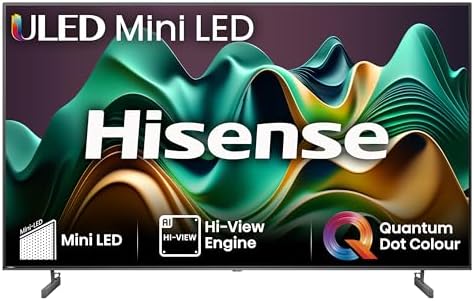
3. Hisense 75U6NQTUK 75" Mini-LED - best big screen

Screen
75" Mini-LED
Refresh rate
60 Hz
Hisense 75U6NQTUK Mini-LED specifications
- Screen size: 75 inch
- Panel: Mini-LED
- Resolution: 3840x2160
- Peak brightness: 600 nits
- Refresh rate: 60 Hz
- HDMI 2.1 ports: 3
- VRR: Yes
- Dolby Vision: Yes
- HDR10+: Yes
- Dolby Atmos: Yes
The Hisense 75U6NQTUK is the big-screen pick. Mini-LED uses thousands of small LEDs with local-dimming zones, so it goes far brighter than OLED while keeping respectable contrast. That brightness is exactly what a 75-inch screen needs in a living room with windows and daytime sport on screen. It peaks at 600 nits and measures 75 inches.
The 75U6NQTUK runs at 60 Hz, carries three HDMI 2.1 ports, supports VRR, and ships Dolby Vision, HDR10+ and Dolby Atmos. It is not a gaming-first TV: the 60 Hz panel caps you at 4K 60 fps on a PS5 or Xbox Series X, where the OLED picks above run 120 Hz. For films, sport and a huge bright-room picture per pound, Mini-LED at this size is the smart buy.
Hisense 75U6NQTUK - pros and cons
4. Hisense 50A7NQTUK 50" QLED - best budget TV

Screen
50" QLED
Refresh rate
60 Hz
Hisense 50A7NQTUK QLED specifications
- Screen size: 50 inch
- Panel: QLED
- Resolution: 3840x2160
- Refresh rate: 60 Hz
- HDMI 2.1 ports: 3
- VRR: Yes
- Dolby Vision: Yes
- HDR10+: Yes
- Dolby Atmos: Yes
The Hisense 50A7NQTUK is the most TV per pound in the catalogue. It is a 50-inch 4K QLED, so the quantum-dot colour layer gives it richer, more accurate colour than a plain LED set at the same price. It supports Dolby Vision, HDR10+ and Dolby Atmos, a full HDR and audio feature set that budget TVs usually drop.
Unusually for the price, the 50A7NQTUK carries three HDMI 2.1 ports and supports VRR, so a PS5 or Xbox Series X gets variable refresh rate even on a budget panel. The honest trade-off is the 60 Hz refresh and QLED contrast: black levels are grey next to OLED, and there is no high-refresh gaming. As a second-room TV or a first 4K set on a tight budget, it is hard to beat.
Hisense 50A7NQTUK - pros and cons
Radar · 0-100 scores
- Sony BRAVIA 8 II 65" QD-OLED
- LG OLED B3 55" 4K Smart TV
- Hisense 75U6NQTUK 4K Mini-LED TV
- Hisense 50A7NQTUK 4K Smart TV
Best TV UK 2026 spec sheet
| Spec | BRAVIA 8 II | LG OLED B3 | Hisense U6 75" | Hisense A7 50" |
|---|---|---|---|---|
| Screen size | 65 inch | 55 inch | 75 inch | 50 inch |
| Panel | QD-OLED | OLED | Mini-LED | QLED |
| Resolution | 4K | 4K | 3840x2160 | 3840x2160 |
| Refresh rate | 120 Hz | 120 Hz | 60 Hz | 60 Hz |
| Peak brightness | — | — | 600 nits | — |
| HDMI 2.1 ports | 4 | 2 | 3 | 3 |
| VRR | Yes | Yes | Yes | Yes |
| ALLM | Yes | Yes | — | — |
| Dolby Vision | Yes | Yes | Yes | Yes |
| HDR10+ | — | — | Yes | Yes |
| Dolby Atmos | Yes | Yes | Yes | Yes |
How to choose a TV in 2026
Match the panel to the room, not the brand
A dark room or a dedicated film setup rewards OLED or QD-OLED: per-pixel black is the single biggest upgrade to picture quality. A bright living room with windows rewards Mini-LED: its higher peak brightness beats glare that would wash out an OLED. QLED is the value compromise when budget leads the decision.
Gaming buyers should read three numbers
For a PS5 or Xbox Series X, the numbers that matter are refresh rate (120 Hz unlocks 4K 120 fps), HDMI 2.1 port count (each one carries a 4K 120 Hz source) and VRR plus ALLM support. The Sony BRAVIA 8 II and LG OLED B3 hit all three. The Hisense Mini-LED and QLED picks run 60 Hz, so they cap at 4K 60 fps. For a deeper gaming-first ranking, see Best TV for PS5 and Xbox Series X.
Know which HDR format your content uses
Dolby Vision and HDR10+ are dynamic HDR formats that adjust brightness scene by scene. Most films and series carry one or the other, and a TV that supports both never drops to basic HDR10. Sony backs Dolby Vision; Samsung backs HDR10+; Hisense and Panasonic often support both. Check the format your streaming services use before you spend on a premium panel.
OLED vs QLED is the decision most buyers actually face
The contrast-versus-brightness trade-off between OLED and QLED decides most mid-range TV purchases. We break it down with real hardware in OLED vs QLED explained, and the value end of the market in Best budget TV UK 2026.
Verdict
The Sony BRAVIA 8 II 65" QD-OLED is the best TV Compare Electronic tracks in the UK in June 2026: per-pixel black, high peak brightness, 120 Hz, four HDMI 2.1 ports and the strongest processing in the catalogue. The LG OLED B3 55" is the OLED value pick with a 13 ms input lag. The Hisense 75U6NQTUK is the big-screen Mini-LED pick for bright rooms, and the Hisense 50A7NQTUK QLED is the budget pick that still carries HDMI 2.1 and Dolby Vision. Pair any of them with a decent soundbar, because thin TV speakers are the weak spot on every set here.
Frequently asked questions
What is the best TV to buy in the UK in 2026?
The Sony BRAVIA 8 II 65-inch QD-OLED is the best TV Compare Electronic tracks in the UK in June 2026. The BRAVIA 8 II pairs a QD-OLED panel with a 120 Hz refresh rate, four HDMI 2.1 ports, VRR, ALLM and Dolby Vision, so it handles films, sport and PS5 gaming without compromise.
Is OLED or QLED better for a TV?
OLED wins on contrast and black level because each pixel switches off for true black. QLED wins on peak brightness and price. OLED suits dark rooms and films; QLED and Mini-LED suit bright rooms and bigger screens for less money. The right panel depends on your room light and your budget.
What size TV should I buy?
Match screen size to seating distance. At 2 to 2.5 m a 50 to 55-inch TV fills the field of view. At 2.5 to 3.5 m a 65-inch set is the mainstream sweet spot. At 3.5 m or more a 75-inch set earns its size, and Mini-LED scales to big screens more cheaply than OLED.
Do I need HDMI 2.1 on a TV?
You need HDMI 2.1 if you own a PS5 or Xbox Series X and want 4K at 120 fps. Each HDMI 2.1 port carries one 4K 120 Hz source. For films and standard TV, HDMI 2.0 is enough. The Sony BRAVIA 8 II carries four HDMI 2.1 ports; many budget sets carry one or two.
What is the difference between Mini-LED and OLED?
OLED uses self-emissive pixels that switch off for true black and effectively infinite contrast. Mini-LED uses thousands of small backlight LEDs with local-dimming zones, which cannot match OLED black but go far brighter. OLED suits dark rooms; Mini-LED suits bright rooms and big screens at a lower price.
Is a budget TV worth buying in 2026?
Yes. Budget TVs in 2026 keep 4K resolution, QLED colour and often HDMI 2.1 with VRR. The Hisense 50A7NQTUK is a 4K QLED with three HDMI 2.1 ports and VRR at the budget end. You compromise on peak brightness, contrast and processing, not on core features.
What is the best 55 inch TV in the UK?
The LG OLED B3 55-inch is the best 55 inch TV on Compare Electronic's 2026 shortlist. The LG OLED B3 pairs a WOLED panel with a 120 Hz refresh rate, a 13 ms input lag, two HDMI 2.1 ports, VRR, ALLM and Dolby Vision. A 55-inch screen suits a seating distance of 2 to 2.5 m, and OLED gives it true per-pixel black for films in a dim room.