

Wireless charging and heat
Is wireless charging bad for your battery? Heat is the risk. Measured losses, Qi2 vs MagSafe, 80% limits, UK running costs and the UGREEN Aircool cooled stand.
On this page
At a glance
Wireless charging is not bad for a phone battery by itself, but it keeps the phone warmer for longer than a cable, and heat is the main driver of lithium-ion ageing. University of Warwick researchers measured a phone peaking at 30.5°C on an inductive charger against no more than 27°C on a mains cable, and Battery University's data shows a fully charged cell kept at 40°C holds 65% of its capacity after a year, against 80% at 25°C.
The extra wear is small and controllable. A Qi2.2-certified magnetic charger keeps the coils aligned, an 80% charge limit keeps the phone off 100% overnight, and a cooled stand such as the UGREEN Aircool 25W Qi2.2 3-in-1 Charging Stand, £89.98 on Amazon UK at the time of writing (September 2026), removes heat at the source. The wasted electricity costs £0.53 to £1.95 a year on Compare Electronic's calculation at Ofgem's October 2026 unit rate of 26.32p per kWh. Ranked charger picks are in the best wireless charger UK 2026 guide.
Does wireless charging damage a phone battery?
Wireless charging damages a phone battery only through heat, and Apple states that an iPhone limits or pauses charging when the battery gets too warm. Lithium-ion cells lose capacity through chemical side reactions that speed up with temperature: the University of Warwick's WMG team notes that the reaction rate doubles with each 10°C rise, and treats a cell dwelling above 30°C as at elevated temperature.
| Temperature | Stored at 40% charge | Stored at 100% charge |
|---|---|---|
| 0°C | 98% | 94% |
| 25°C | 96% | 80% |
| 40°C | 85% | 65% |
| 60°C | 75% | 60% (after 3 months) |
Heat and a full charge compound each other: a full cell at 40°C keeps 65% after a year, a 40% cell at 25°C keeps 96%. Battery University also states that a cell charged to 4.10 V instead of 4.20 V delivers 600 to 1,000 cycles instead of 300 to 500, the chemistry behind the 80% charge limits on current phones.
- Apple:ideal ambient range 16°C to 22°C; above 35°C "can permanently damage battery capacity".
- Google: charge at about 25°C; avoid six or more hours above 35°C.
- Battery University: charge between 0°C and 45°C, ideally 10°C to 30°C.
Is wireless charging worse for battery health than wired charging?
Wireless charging is slightly worse for battery health than wired charging, because it keeps the phone warm for longer, not because the coil harms the cell. In the University of Warwick study, published in ACS Energy Letters in 2019, the phone on a cable never averaged more than 27°C over three hours. On an aligned inductive charger it peaked at 30.5°C and stayed there for 55 minutes; with the coils misaligned it held 30.5°C for 125 minutes, and the charging base reached 35.3°C.
Fast wired charging produces heat too. ChargerLAB recorded 39.5°C on the back of an iPhone 17 Pro Max 20 minutes into a wired charge on Apple's 40W Dynamic Power Adapter, at about 31 W. The difference is duration: that wired charge reached 80% in 41 minutes, per ChargerLAB.
Charge cycles count the same either way. Apple designs the batteries of the iPhone 15 and later to keep 80% of their original capacity at 1,000 complete charge cycles under ideal conditions, against 500 cycles for the iPhone 14 and earlier. Google rates the Pixel 8a and later at 80% for about 1,000 cycles. At one full cycle a day, 1,000 cycles last 2.7 years on Compare Electronic's arithmetic, and "ideal conditions" is where heat comes in.
How efficient is wireless charging compared with a cable?
Wireless charging uses 39% to 80% more electricity than a cable for the same charge, according to OneZero's widely cited independent measurement. Eric Ravenscraft of OneZero metered a Google Pixel 4 from empty to full at the wall socket in August 2020:
- USB-C cable: 14.26 Wh.
- Google Pixel Stand: 19.8 Wh, 39% more.
- Flat Yootech Qi pad, aligned: 21.01 Wh, 47% more.
- Same pad, misaligned: 25.62 Wh, 80% more.
- Idle:each wireless charger drew about 6 Wh over 24 hours with no phone on it; the cable's plug drew no measurable power.
The missing energy becomes heat in the coils and the phone, which ties efficiency to battery wear. The Wireless Power Consortium says Qi2's Magnetic Power Profile "improves energy efficiency by reducing the energy loss that can happen when the phone or the charger is not aligned". Alignment cuts the loss; it does not remove the conversion between two coils, so a magnetic charger still wastes more energy than a cable.
How much does wireless charging cost to run in the UK?
Wireless charging costs a UK household £0.53 to £1.95 a year more than a cable for one full phone charge a day, on Compare Electronic's calculation at Ofgem's price cap unit rate of 26.32p per kWh for 1 October to 31 December 2026 (GB average, Direct Debit).
| Charger | Energy per charge, Pixel 4 | Extra cost a year, Pixel 4 | Energy per charge, 5,000 mAh | Extra cost a year, 5,000 mAh |
|---|---|---|---|---|
| USB-C cable (baseline) | 14.26 Wh | Baseline (£1.37 a year in total) | 25.46 Wh | Baseline (£2.45 a year in total) |
| Google Pixel Stand | 19.80 Wh (+39%) | £0.53 | 35.36 Wh | £0.95 |
| Flat Qi pad, aligned | 21.01 Wh (+47%) | £0.65 | 37.52 Wh | £1.16 |
| Flat Qi pad, misaligned | 25.62 Wh (+80%) | £1.09 | 45.75 Wh | £1.95 |
| Wireless charger left idle | About 6 Wh a day | £0.58 | About 6 Wh a day | £0.58 |
The money is trivial: the worst case, a misaligned pad charging a 5,000 mAh phone daily, adds 7.40 kWh and £1.95 a year, and an aligned pad adds £3.47 over three years, less than the £19.99 UGREEN 25W Qi2.2 Wireless Charger Pad. Those kilowatt-hours are released as heat in the charger and the phone, which is why alignment matters more for the battery than the bill.
Do cooled wireless chargers protect the battery?
Cooled wireless chargers reduce the heat that ages a battery and hold full speed for longer. Apple states that software may limit charging above 80% if an iPhone's battery gets too warm on a MagSafe Charger; a cooler phone avoids that pause. The temperature figures below are the makers' own claims.
UGREEN Aircool 25W Qi2.2 3-in-1 Charging Stand

UGREEN Aircool 25W Qi2.2 3-in-1 specifications
- Phone output: up to 25 W
- Standard: Qi2.2
- Devices at once: 3
- Cooling: TEC with fan
- Power supply included: Yes (45 W, UK plug)
- Cable: 1 m USB-C to USB-C
- AirPods and Apple Watch output: 5 W each
The UGREEN Aircool 25W Qi2.2 3-in-1 Charging Stand is the cooled charger to buy for a desk or bedside. UGREEN fits a thermoelectric (TEC) cooler and a fan behind the phone pad and claims a surface temperature as low as 11°C, up to 18°C cooler than an uncooled charger, at under 15 dB. UGREEN rates it at 25 W for the iPhone 16, iPhone 17 and iPhone 18 Pro, 15 W for Pixel and Galaxy phones, and 5 W each for an Apple Watch and AirPods.
The UGREEN Aircool 3-in-1 costs £89.98 on Amazon UK at the time of writing (September 2026) and ships with a 45 W UK power supply and a 1 m USB-C cable. UGREEN claims 0 to 50% in 26 minutes on an iPhone 17 Pro Max, and a display shows the phone's surface temperature and live wattage. The stand suits iPhone owners with an Apple Watch and AirPods; the uncooled Belkin UltraCharge Pro 3-in-1 Qi2.2 25W costs £109.99.
UGREEN Aircool 25W Qi2.2 3-in-1 - pros and cons
Where to buy
Check price
UGREEN Aircool 25W Qi2.2 Car Charger

The UGREEN Aircool 25W Qi2.2 Car Charger brings a cooling fan to the dashboard, where sat-nav and summer sun combine. It is Qi2.2 certified for 25 W, costs £31.99 on Amazon UK at the time of writing (September 2026) and needs a 45 W USB-C car adapter, sold separately.
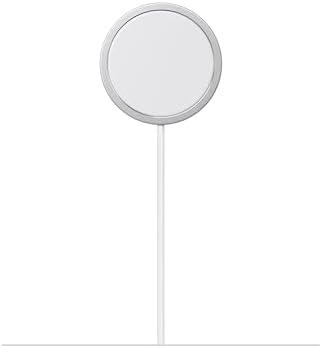
Certified uncooled chargers still remove the misalignment case measured above. The Apple MagSafe Charger (1m) costs £38.00 and the UGREEN 25W Qi2.2 Wireless Charger Pad £19.99 on Amazon UK at the time of writing (September 2026).
Radar · 0-100 scores
- Aircool 25W Qi2.2 3-in-1 Charging Stand
- MagSafe Charger (1m)
- Aircool 25W Qi2.2 Car Charger
- 25W Qi2.2 Wireless Charger Pad
Qi2 vs MagSafe: which is better for the battery?
Qi2 and MagSafe are equally kind to a battery at the same wattage, because both use the same magnetic alignment; the difference is certification and speed. Apple's MagSafe design, introduced with the iPhone 12 in 2020, became the basis of Qi2, which the Wireless Power Consortium launched in November 2023 at 15 W. On 23 July 2025 it launched Qi v2.2.1, branded Qi2 25W and widely called Qi2.2, with "nearly 70% more power than the original Qi2".
- Alignment: the magnet ring centres the coils, removing the misaligned case where OneZero measured 80% extra energy.
- Certification:"Qi2.2 certified" or "Qi2 25W" means Wireless Power Consortium certification; "compatible with MagSafe" is a marketing phrase.
- Speed: Apple lists MagSafe and Qi2 charging at up to 25 W for the iPhone 18 Pro.
On the radar above, the UGREEN Aircool 3-in-1 is the only hero product with a power supply in the box and three charging spots, while the UGREEN pad and car mount carry the longest cables at 1.5 m. Every current Qi2.2 pick is compared in best wireless charger UK 2026.
How much slower is wireless charging than wired?
Wireless charging delivers roughly a quarter to a half less charge than a cable in the first 30 minutes: a cable added 16 to 37 percentage points more on 2025 and 2026 flagships in CNET's charging measurements of 33 phones, reported by MacRumors in May 2026.
| Phone | Wired, 30 minutes | Wireless, 30 minutes | Gap |
|---|---|---|---|
| iPhone 17 Pro | 74% | 55% | 19 points |
| iPhone 17 Pro Max | 69% | 53% | 16 points |
| iPhone 17 | 69% | 49% | 20 points |
| Samsung Galaxy S26 Ultra | 76% (60 W charger) | 39% | 37 points |
Time to 50% tells the same story. ChargerLAB measured an iPhone 17 Pro Max reaching 50% in 20 minutes on Apple's 40W Dynamic Power Adapter, while CNET's 53% in 30 minutes puts the Qi2.2 figure close to half an hour. For the iPhone 18 Pro, Apple quotes 50% in around 15 minutes on a 60 W-capable USB-C adapter with Adjustable Voltage Supply, and 50% in 30 minutes on a MagSafe Charger with a 35 W or stronger adapter.
The Apple 40W Dynamic Power Adapter(£39.00 on Amazon UK at the time of writing, September 2026) is Apple's plug for the 15-minute figure. The Galaxy S26 Ultra shows the widest gap, 37 points. Wall chargers are ranked in best fast charger UK 2026.
Is it bad to charge a phone overnight?
Charging a phone overnight is not harmful on a current iPhone, Galaxy or Pixel with its battery-care setting switched on, because the phone holds the charge below 100% for most of the night. Battery University names a fully charged battery kept at elevated temperature as "the worst situation".
- iPhone: Optimised Battery Charging delays charging past 80% in certain situations; the iPhone 15 and later can instead stop at a fixed 80% to 100% limit.
- Samsung Galaxy: Sleep time protection holds 80% and charges to 100% just before waking, after about 2 weeks of learning.
- Google Pixel: Adaptive Charging finishes just before the usual unplug time, after about 14 days of learning.
Wireless adds warmth overnight. A phone on a pad under a pillow or on a duvet cannot shed heat, and the misaligned charging base reached 35.3°C in the Warwick study. A stand on a hard bedside table, away from a radiator, suits a bedroom better than a flat pad in bed.
Which phone settings reduce battery wear?
A charge limit is the most effective battery setting on current phones, and Apple, Samsung and Google all offer one. Samsung's Battery protection menu arrived with One UI 6.1, replacing the older 85% Protect battery switch.
| Phone | Setting | What it does |
|---|---|---|
| iPhone 15 and later | Charge limit and Optimised Battery Charging | Stops at 80%, 85%, 90%, 95% or 100%; at 100%, charging past 80% can be delayed |
| iPhone 14 and earlier | Optimised Battery Charging | Delays charging past 80% in certain situations |
| Samsung Galaxy (One UI 6.1 and later) | Battery protection | Basic: stops at 100%, restarts at 95%. Sleep time protection: 80% until just before waking. Maximum: 80% to 95% |
| Google Pixel 6a and later | Adaptive Charging or Limit to 80% | Adaptive Charging finishes just before unplugging; Limit to 80% still charges fully every 10th cycle |
| Google Pixel 6a and later | Battery Health Assistance | Lowers maximum voltage in stages from 200 to 1,000 cycles; always on from Pixel 9a |
The trade-off is range: an 80% limit gives up a fifth of capacity every day. The longest-lasting phones absorb that most easily, and they are ranked in longest battery life smartphones 2026.
Does a phone case make wireless charging hotter?
A thick or non-magnetic case makes wireless charging hotter and less efficient, because it pushes the coils apart and traps heat against the phone's back. Apple states that charging an iPhone inside "certain styles of cases may generate excess heat, which can affect battery capacity", and UGREEN rates its Aircool Qi2.2 chargers for magnetic cases up to 3 mm thick.
- Magnetic cases: a slim MagSafe or Qi2 case keeps alignment; a thick rugged case weakens it.
- Cards and metal: cards, metal plates and grip rings trigger foreign object detection, which UGREEN lists on its Aircool chargers.
- No magnets: the Galaxy S26 Ultra needs a Qi2 magnetic case to stay aligned on a stand or car mount.
When should a phone charge wirelessly, and when by cable?
Wireless suits long, slow, cool charging sessions, and a cable suits fast top-ups and any situation where the phone is already warm.
| Situation | Use | Why |
|---|---|---|
| Overnight at the bedside | Wireless stand, with an 80% limit or overnight setting on | Speed buys nothing overnight; the setting keeps the phone off 100% |
| Quick top-up before leaving | Wired, 30 W or more USB-C PD | 16 to 37 points more charge in 30 minutes (CNET) |
| Gaming, video calls or navigation while charging | Wired, or a cooled charger | The phone is already warm; iOS may pause above 80% |
| Car sat-nav in summer | Cooled mount or a cable | Apple advises against ambient heat above 35°C |
| Desk during the working day | Wireless stand | Short top-ups keep the battery mid-range, away from 100% |
| Thick, wallet or metal-plated case | Wired, or remove the case | Apple warns some cases generate excess heat |
| Phone without built-in magnets | Wired, or a Qi2 magnetic case | Misalignment: 80% more energy (OneZero), 125 minutes at peak heat (Warwick) |
| Room above 30°C in a heatwave | Wired, away from direct sun | Warwick treats a cell above 30°C as at elevated temperature |
Routing the cable behind a desk stand is covered in how to hide desk cables. Away from a socket, magnetic power banks are compared in best power bank UK 2026.
What should UK buyers check before switching to wireless charging?
- The plug: the Apple MagSafe Charger (1m), UGREEN pad and UGREEN car mount ship without one. Apple asks for 30 W or more for 25 W, and UGREEN recommends 45 W. The Anker 735 Charger (65W), £21.25 on Amazon UK at the time of writing (September 2026), supplies 65 W from one USB-C port, and the UGREEN Nexode 30Wat £11.84 covers Apple's 30 W minimum.
- UK plug in the box: the UGREEN Aircool 25W Qi2.2 3-in-1 Charging Stand includes a 45 W UK wall charger.
- Consumer Rights Act 2015: a charger that overheats or stops working is faulty, and buyers have 30 days from delivery to reject it for a full refund from the retailer.
- Energy:Ofgem's cap sets electricity at 26.32p per kWh plus a 54.83p daily standing charge from 1 October to 31 December 2026.
Verdict: is wireless charging bad for your battery?
Wireless charging is not bad for a phone battery when the coils stay aligned, the phone stays cool and a charge limit keeps it off 100% overnight. Heat is the mechanism, and the lost electricity costs £0.53 to £1.95 a year at the October 2026 price cap. The UGREEN Aircool 25W Qi2.2 3-in-1 Charging Stand at £89.98 is the pick for battery-conscious iPhone owners, the UGREEN Aircool 25W Qi2.2 Car Charger at £31.99 covers the hottest place a phone charges, and the Apple MagSafe Charger (1m) at £38.00 and UGREEN 25W Qi2.2 Wireless Charger Pad at £19.99 give certified alignment for less. For a fast top-up, a cable still wins by 16 to 37 points in 30 minutes.
Frequently asked questions
Is wireless charging bad for your battery?
Wireless charging is not bad for a phone battery by itself, but it keeps the phone warmer for longer than a cable, and heat is the main cause of lithium-ion ageing. University of Warwick researchers measured a phone peaking at 30.5°C on an inductive charger against no more than 27°C on a cable. A Qi2.2 magnetic charger, an 80% charge limit and a thin case keep the extra wear small.
Does wireless charging damage the battery more than wired charging?
Slightly, and only through heat rather than the charging method itself. In the University of Warwick's 2019 study, a misaligned inductive charger held a phone at 30.5°C for 125 minutes, against 55 minutes when aligned and a 27°C ceiling on a cable. Charge cycles count the same either way: Apple designs the iPhone 15 and later to keep 80% capacity after 1,000 complete cycles.
Is it bad to charge a phone overnight?
Charging overnight is not harmful on a current iPhone, Samsung Galaxy or Google Pixel with battery care switched on. iPhone Optimised Battery Charging delays charging past 80%, Samsung's Sleep time protection holds 80% until just before waking, and Pixel Adaptive Charging finishes just before the usual unplug time. Without these settings the phone sits at 100% for hours, which Battery University identifies as a stress on lithium-ion cells.
How much energy does wireless charging waste?
Wireless charging used 39% to 80% more electricity than a USB-C cable in OneZero's measurement of a Google Pixel 4: 14.26 Wh by cable, 19.8 Wh on a Pixel Stand, 21.01 Wh on an aligned flat pad and 25.62 Wh on a misaligned one. At Ofgem's October 2026 price cap of 26.32p per kWh, one wireless charge a day costs £0.53 to £1.95 a year extra.
Is Qi2 or MagSafe better for battery health?
Neither is better for battery health at the same wattage, because Qi2 is built on Apple's MagSafe magnetic design and both hold the coils in alignment. Alignment matters: a misaligned flat pad used 80% more energy than a cable in OneZero's measurement. Qi2.2, which the Wireless Power Consortium launched as Qi2 25W in July 2025, raises the ceiling to 25 W for phones such as the iPhone 18 Pro.
Should the 80% charge limit be turned on?
The 80% charge limit is worth turning on for any phone that ends the day with charge to spare. Battery University reports that charging a lithium-ion cell to 4.10 V instead of 4.20 V lifts cycle life from 300 to 500 cycles to 600 to 1,000. The iPhone 15 and later offer limits from 80% to 100%, Samsung's Maximum mode offers 80% to 95%, and Pixel 6a and later offer Limit to 80%.
Does a phone case make wireless charging hotter?
A thick or non-magnetic case can make wireless charging hotter. Apple states that charging an iPhone inside certain styles of cases may generate excess heat, which can affect battery capacity. UGREEN rates its Aircool Qi2.2 chargers for magnetic cases up to 3 mm thick. A slim MagSafe or Qi2 magnetic case keeps the coils aligned, which wastes less energy as heat.
Do cooled wireless chargers help battery health?
Cooled wireless chargers target heat, the main cause of battery ageing. UGREEN claims its Aircool 25W Qi2.2 3-in-1 Charging Stand runs up to 18°C cooler than uncooled chargers, using a thermoelectric cooler and a fan. The stand costs £89.98 on Amazon UK at the time of writing (September 2026) and includes a 45 W UK power supply. A cooler iPhone also avoids the 80% charging pause iOS applies when the battery gets too warm.