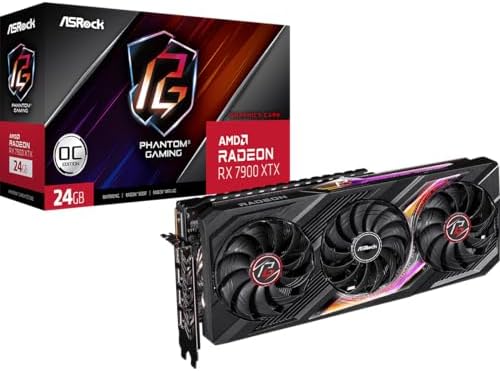
ASRock RX 7900 XTX Phantom Gaming
ASRock's premium Phantom Gaming take on the 7900 XTX, with 24GB of GDDR6, triple-fan cooling, and a 2615 MHz boost clock for 4K rasterisation maximalists.
We may earn a commission on purchases via this link. It never affects our scores or rankings.
Why we rate it
- Generous 24GB VRAM allocation
- Strong 4K rasterisation
- Phantom Gaming triple-fan cooling
- DisplayPort 2.1 outputs
- Weak ray tracing versus Nvidia
- FSR is no DLSS 4
Where the ASRock RX 7900 XTX Phantom Gaming wins and loses
Specifications
General info
Memory
Compute units
Interface
Power
Display outputs
Watch it in action
ASRock RX 7900 XTX Phantom Gaming vs MSI GeForce RTX 4080 Super 16GB
| ASRockASRock RX 7900 XTX Phantom GamingThis page | MSIGeForce RTX 4080 Super 16GB | |
|---|---|---|
| Overall score | 75 /100 | 75 /100 |
| VRAM | 24 GBBetter | 16 GB |
| Boost clock | 2615 MHz | — |
| Memory type | GDDR6 | — |
| TDP | 355 W | — |
| Cuda cores | 12288 | — |
| Memory bus bit | 384 | — |
Is the ASRock RX 7900 XTX Phantom Gaming right for you?
If you find this card at a meaningful discount versus premium Sapphire Nitro+ alternatives, and you prioritise rasterisation and VRAM over ray tracing, the ASRock Phantom Gaming offers genuine value.
If you want strong RT performance or DLSS 4 multi-frame generation, this card simply can't compete with Nvidia options. Look at the RTX 5080 or RTX 4090 second-hand instead.
Before you buy
Yes. ASRock's GPU lineup has improved significantly in recent years, with the Phantom Gaming line offering competitive build quality and cooling at sensible prices. Warranty support and reliability are reasonable.
Only at a clear discount versus the RX 9070 XT or RTX 5070 Ti. The 7900 XTX remains a strong rasterisation card with massive VRAM, but newer cards offer better RT and FSR 4 or DLSS 4 features.
The 9070 XT offers significantly better ray tracing and FSR 4 support. The 7900 XTX wins on raw VRAM at 24GB versus 16GB and slightly stronger rasterisation. Pick based on what matters most to you.
AMD recommends 800W and that's the realistic floor. With a power-hungry CPU like a Core i9 or Ryzen 9, step up to a quality 1000W unit for transient spike headroom.
Alternatives & similar graphics cards