Home/Compare/Graphics Cards/ASUS Radeon RX 9070 XT
ASUS

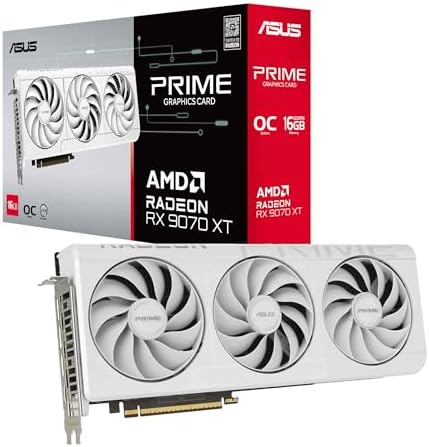
ASUS Radeon RX 9070 XT

ASUS's higher-tier take on AMD's 1440p flagship, with a hefty triple-fan cooler, aggressive factory overclock, and a 304W power budget for sustained performance.

In stock16GB GDDR6RDNA 4 architectureTriple-fan coolerFactory overclockedPCIe 5.0
ASUS Radeon RX 9070 XT
16GB GDDR6RDNA 4 architectureTriple-fan coolerFactory overclockedPCIe 5.0Watch review
Compare prices

Affiliate links, your price stays the same. How we check prices →

Our verdict

A premium-built 9070 XT with excellent 1440p performance, headroom-rich cooling, and proper ray tracing at this tier.

75/100
vs. other high-end 1440p GPUs (£550 to £750)
Scored within its class as a high-end 1440p AMD card, not against flagship 4K-focused GPUs like the RTX 5080 or 5090.
Best price found
£615
30-day low £600 · Average £643
See £615 deal at Amazon Uk

What we think

Swipe or tap to explore what we like, what to watch for, and who it's for

How it performs & what it pairs with

Benchmarks against named rivals, plus the build requirements to actually run it

Benchmarks
1440p ultra settings, upscaling off unless noted
Cyberpunk 2077 (1440p ultra, RT off)
ASUS RX 9070 XT
121 fps avg
RTX 5070 Ti
113 fps avg
RX 7800 XT
90 fps avg
Cyberpunk 2077 (1440p ultra, RT ultra)
ASUS RX 9070 XT
63 fps avg
RTX 5070 Ti
73 fps avg
RX 7800 XT
42 fps avg
Hogwarts Legacy (4K high, FSR Quality)
ASUS RX 9070 XT
80 fps avg
RTX 5070 Ti
82 fps avg
RX 7900 XT
73 fps avg
Test bench

Tested with a Ryzen 7 9800X3D, 32GB DDR5-6000, Windows 11 24H2 on an 850W PSU. Stock OC profile, latest driver at time of testing.

Build compatibility
What your PC needs
Power supply
700W is the official recommendation given the 304W TDP. With a high-end CPU, step up to 750W or 850W for transient spike headroom.
Case clearance
The 2.5-slot triple-fan design fits most mid-tower cases. Strict 2-slot only ITX builds need to look at slimmer partner cards instead.
Motherboard slot
PCIe 5.0 x16 slot, fully backward compatible with PCIe 4.0 boards. No meaningful performance difference between 4.0 and 5.0 at this card's bandwidth.
!
CPU pairing
Pairs well with a Ryzen 7 7800X3D, Ryzen 9 7950X, Core i7 14700K or better. Older CPUs will bottleneck the card noticeably at 1440p, undercutting the OC advantage.
Cooling and noise
Triple Axial-Tech fans with a phase-change thermal pad keep the chip cool. Quiet under typical load, audible only during sustained stress.

Performance breakdown

Scored relative to the class, not against flagship models

vs. other high-end 1440p GPUs (£550 to £750)
75/100
Best in class scored 92
Class average 75
Lowest in class 55
1440p rasterisation93 / 100
Top of its price bracket with the OC bonus, edging past reference 9070 XTs
4K rasterisation81 / 100
Strong for entry 4K, ultra settings need FSR in newer titles
Ray tracing70 / 100
Big jump over RDNA 3, still trailing GeForce in heaviest RT loads
Sustained performance88 / 100
Higher power limit and stronger cooling hold boost clocks longer than reference

Watch it in action

Powered byYouTube

Who this is right for

Picture yourself in these scenarios. How well does this fit?

1440p high-refresh enthusiast
Running a 144Hz or 240Hz 1440p monitor and chasing every frame. The factory OC and beefier cooler hold boost clocks longer than reference designs in long sessions.
Excellent fit
Entry-level 4K gamer
Plays at 4K with FSR enabled. Gets a smooth experience in most titles, and the extra cooling headroom helps in heavy RT scenes where reference 9070 XTs run hotter.
Good fit
Path tracing enthusiast
Wants Cyberpunk with full path tracing or the next big RT showcase cranked. RDNA 4 has closed the gap but GeForce cards still take the lead at the top end.
Okay fit
Compact case builder
Building in a small ITX or mATX case. This triple-fan card is on the chunky side, and the slimmer ASUS PRIME or non-ASUS 2-slot alternatives are a better fit.
Look elsewhere

What every spec actually means

Numbers translated into real-world impact

vram_gb16

Ample memory for 1440p and 4K with most modern games. Beats 12GB rivals when texture-heavy titles push VRAM hard, which is happening more often in recent releases.

tdp_w304

Higher than AMD's reference 9070 XT, reflecting the factory overclock and partner card design. A quality 700W PSU is the official recommendation, with 750W more sensible alongside a high-end CPU.

boost_clock_mhz2970

Pushed well above AMD's reference 9070 XT specifications. Translates to a few percent of extra performance in real games, the kind of bump you'd usually have to dial in manually.

memory_bandwidth_gbps640

Strong bandwidth thanks to 20 Gbps GDDR6 on a 256-bit bus. Comfortable for 1440p gaming, slightly behind GDDR7 rivals at 4K with the heaviest textures, but only just.

ray_tracing_generation3rd Gen

AMD's biggest leap in ray tracing yet. Closes most of the gap to current GeForce hardware in mid-load RT scenarios, though heavy path tracing still favours the green team.

Complete specifications

Verified across manufacturer datasheets and retailer spec tables

All specs
slots
2.5
2 to 3 slots typical, this is 2.5
tdp w
304
200 to 300W class range, this sits high at 304
vram gb
16
12 to 16GB typical, this maxes the range
gpu chip
Navi 48
·
fan count
3
2 to 3 typical, this has 3
cuda cores
4096
·
hdmi count
1
1 to 2 typical, this has 1
memory type
GDDR6
GDDR6 or GDDR7 in class, this is GDDR6
architecture
RDNA 4
·
hdmi version
2.1b
HDMI 2.1 standard across class
pcie version
PCIe 5.0
PCIe 4.0 or 5.0 in class, this is 5.0
release year
2025
·
base clock mhz
1660
·
game clock mhz
2480
·
lithography nm
4
4nm or 5nm typical, this is 4nm
memory bus bit
256
192 to 256-bit typical, this is 256-bit
boost clock mhz
2970
2400 to 3000 MHz typical, this is at the top at 2970
displayport count
3
2 to 3 typical, this has 3
memory speed gbps
20
18 to 28 Gbps class range, this is 20
ray tracing cores
64
·
displayport version
2.1a
DP 1.4a or 2.1 in class, this is 2.1a
factory overclocked
true
·
psu recommendation w
700
650 to 850W typical, this is 700
memory bandwidth gbps
640
540 to 950 GB/s class range, this sits mid
ray tracing generation
3rd Gen
·

Common questions

The things people ask before buying this product

Is the ASUS 9070 XT worth it over the PRIME version?

Only if you want the bigger cooler and slightly higher OC. Both cards use the same chip and deliver similar gaming performance. The PRIME is the smart-money pick of ASUS's 9070 XT range for most buyers.

What PSU do I need for the ASUS 9070 XT?

ASUS recommends 700W. With a power-hungry CPU like a Ryzen 9 or Core i9, step up to a quality 750W or 850W unit. The 304W TDP is notably higher than AMD's reference, so don't skimp on the PSU.

Will the ASUS 9070 XT fit my case?

It's a 2.5-slot triple-fan card. Fits most mid-tower cases without issue but won't squeeze into strict 2-slot only ITX builds. Always check your case's GPU clearance before buying.

How does ray tracing performance compare to Nvidia?

Much better than AMD's previous generation, but still behind current GeForce cards in heavy path-traced titles. Mid-load RT runs well, but max-everything Cyberpunk RT still favours an RTX 5070 Ti or above.

Compare Electronic editors
Independent graphics cards comparison since 2025
Every product is scored against its own product class, not against flagship models. Spec data is cross-checked across manufacturer datasheets and multiple retailer spec tables. Prices are verified daily. We never rank by affiliate commission.
Read our methodology