Home/Compare/CPUs/Intel 20 Core i7 14700F Raptor Lake Refresh CPU/Processor
Intel

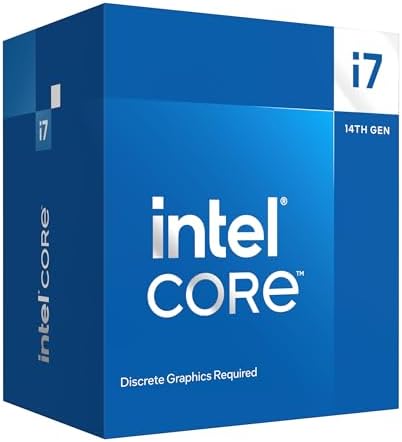
Intel 20 Core i7 14700F Raptor Lake Refresh CPU/Processor

Intel's 14th-gen 20-core workhorse for gamers and creators, with a bundled Laminar RM1 cooler, DDR4 or DDR5 flexibility, and no iGPU premium in the price.

In stock20 cores / 28 threads5.4 GHz boostLaminar RM1 includedLGA1700 socketDDR4 and DDR5
Intel 20 Core i7 14700F Raptor Lake Refresh CPU/Processor
20 cores / 28 threads5.4 GHz boostLaminar RM1 includedLGA1700 socketDDR4 and DDR5
Compare prices

Affiliate links, your price stays the same. How we check prices →

Our verdict

A capable 20-core Intel chip with a bundled cooler and DDR4 flexibility, at a lower price than the i9 with less thermal drama.

73/100
vs. other mid-to-high-end LGA1700 gaming CPUs
Scored within its class as a mid-to-high-end LGA1700 gaming and productivity CPU, not against AMD AM5 chips or flagship unlocked Intel processors.
Best price found
£296
30-day low £296 · Average £297
See £296 deal at Amazon Uk

What we think

Swipe or tap to explore what we like, what to watch for, and who it's for

How it performs & what it pairs with

Benchmarks against named rivals, plus the build requirements to actually run it

Benchmarks
Stock power limits, Laminar RM1, RTX 5070, DDR5-5600
Counter-Strike 2 (1080p competitive)
Core i7-14700F
432 fps avg
Core i9-14900KF
490 fps avg
Ryzen 7 9800X3D
562 fps avg
Cinebench R23 multi-core
Core i7-14700F
33200 pts
Core i9-14900KF
40200 pts
Ryzen 9 9950X
43800 pts
Cyberpunk 2077 (1440p ultra, RT off)
Core i7-14700F
118 fps avg
Core i9-14900KF
136 fps avg
Ryzen 7 9800X3D
145 fps avg
Test bench

Tested with RTX 5070, 32GB DDR5-5600, Windows 11 24H2. Stock Intel power settings, Laminar RM1, latest microcode applied.

Build compatibility
What your PC needs
LGA1700 socket
Compatible with Intel 700 and 600 series boards. Z690 or Z790 for best feature support. B660 and H670 boards lock the multiplier, which doesn't matter here since the F is not overclockable.
Laminar RM1 cooler included
The Laminar RM1 handles gaming and mixed use at stock comfortably. For sustained all-core rendering at up to 219W, an aftermarket tower or 240mm AIO is worth adding.
DDR4 or DDR5 depending on board
DDR4 reuse is possible on compatible boards, saving cost for upgraders. DDR5 on a new build delivers faster speeds.
!
No integrated graphics
The F suffix means no iGPU. A discrete GPU must be present at all times, including initial setup and BIOS.
!
Apply latest microcode first
Update BIOS to the latest version with current Intel microcode before sustained workloads. Intel 14th gen chips had documented stability issues addressed by microcode updates.

Performance breakdown

Scored relative to the class, not against flagship models

vs. other mid-to-high-end LGA1700 gaming CPUs
73/100
Best in class scored 96
Class average 74
Lowest in class 50
Gaming performance80 / 100
Strong gaming, trails i9 by a small margin and AMD V-Cache chips more notably
Multi-threaded performance88 / 100
20 cores scale well in rendering and encoding
Single-threaded performance88 / 100
5.4 GHz Turbo Boost Max 3.0
Value for money86 / 100
Bundled cooler plus lower price gives good overall value on LGA1700

Who this is right for

Picture yourself in these scenarios. How well does this fit?

LGA1700 upgrader
Already on an Intel 600 or 700 series board and wants the best 14th gen performance without paying i9 prices. The i7-14700F slots in with the bundled cooler and delivers strong performance.
Excellent fit
Budget gaming and productivity builder
Wants a capable 20-core chip at a lower price than the i9 with a bundled cooler to save on the total build. Gaming and multi-threaded performance are close to the i9 at a lower cost.
Good fit
DDR4 reuse builder
Has existing DDR4 memory and wants to reuse it on LGA1700 to avoid the cost of moving to DDR5. The i7-14700F and LGA1700 support both DDR4 and DDR5 depending on the board.
Good fit
Fresh build buyer wanting upgradeable platform
Starting from scratch and wants a platform they can upgrade for the next few years. LGA1700 is end of life with no further CPU upgrades. AM5 or LGA1851 are better choices for new builds.
Look elsewhere

What every spec actually means

Numbers translated into real-world impact

core_count20

Eight Performance cores plus twelve Efficiency cores. P-cores handle gaming and demanding single-threaded work. E-cores handle background tasks, keeping the P-cores focused and maintaining system responsiveness.

boost_clock_ghz5.4 GHz

5.4 GHz via Turbo Boost Max 3.0 on the best cores. Fast enough for competitive gaming and single-threaded workloads without the extreme power draw of the i9's 6 GHz ceiling.

tdp_w65W

65W base is the lowest for any 20-core Intel chip. The included Laminar RM1 handles this comfortably. Under sustained all-core load, actual draw can reach 219W, so heavier workloads benefit from an aftermarket cooler.

stock_cooler_includedtrue

Intel Laminar RM1 included in the box. Adequate for gaming and mixed everyday use at stock clocks. A genuine cost saving for builders who don't already own an aftermarket cooler.

memory_typeDDR5, DDR4

Either DDR4 or DDR5 is supported depending on your motherboard. DDR4 reuse is a real budget saving for upgraders. DDR5 delivers faster speeds for new builds.

Complete specifications

Verified across manufacturer datasheets and retailer spec tables

All specs
aes
true
hardware AES standard on 14th gen
avx
AVX2
AVX2 standard on 14th gen
smt
true
HyperThreading on P-cores, single thread on E-cores
tdp w
65
65W base; actual all-core draw can reach 219W under load
family
Core i7
·
socket
FCLGA1700
FCLGA1700, end-of-life platform, no further CPU upgrades
chipset
Intel 700 Series and Intel 600 Series
Intel 700 and 600 series boards, Z690/Z790 recommended for performance
e cores
12
12 Efficiency cores for background tasks
p cores
8
8 Performance cores with HyperThreading, up to 5.4 GHz
core count
20
20 total cores, competitive with top desktop CPUs
generation
14th gen
14th gen Raptor Lake Refresh
max temp c
100
100°C junction, can approach this under all-core load
pcie lanes
20
20 PCIe lanes standard for LGA1700
l2 cache mb
28
28MB L2 across 20 cores
l3 cache mb
33
33MB L3
max power w
219
219W under sustained all-core load; Laminar RM1 adequate for gaming, not for sustained all-core
memory type
DDR5, DDR4
DDR4 or DDR5, depending on motherboard
x64 support
true
·
manufacturer
Intel
·
pcie version
5
PCIe 5.0 and 4.0 on 700-series boards
release date
Q1'24
Q1 2024, current pricing reflects LGA1700 end of life
thread count
28
28 threads: 16 from P-cores, 12 from E-cores
max memory gb
192
192GB max
base clock ghz
2.1
2.1 GHz base; real gaming and workload clocks are far above this
lithography nm
10
Intel 10nm Enhanced SuperFin
market segment
Desktop
·
virtualization
true
Intel VT-x supported
boost clock ghz
5.4
5.4 GHz Turbo Boost Max 3.0, 600 MHz below i9-14900KF
memory channels
2
2-channel DDR4 or DDR5
memory speed max mhz
5600
5600 MHz DDR5 officially; DDR4-3200 official with faster kits typically running fine
stock cooler included
true
Intel Laminar RM1 included, adequate for gaming and stock workloads

Common questions

The things people ask before buying this product

What is the difference between the i7-14700F and i9-14900KF?

The i9 has 16 E-cores versus 12, a higher 6.0 GHz boost versus 5.4 GHz, and an unlocked multiplier for overclocking. The i9 also draws significantly more power at peak. The i7 includes a cooler; the i9 doesn't. For most gaming builds, the i7 is the better value.

Does the i7-14700F include a cooler?

Yes. The Intel Laminar RM1 is included. It handles gaming and everyday workloads at stock comfortably. For sustained rendering or heavy encoding, an aftermarket cooler is recommended.

Can I use DDR4 with the i7-14700F?

Yes, depending on your motherboard. LGA1700 boards support either DDR4 or DDR5 (not both on the same board). For upgraders with existing DDR4 memory, this is a real cost saving.

Should I buy LGA1700 or switch to AM5?

For an upgrade to an existing LGA1700 build, yes. For a new build, no. LGA1700 is end of life with no further CPU upgrades. AM5 or Intel LGA1851 are better foundations for a new system.

Compare Electronic editors
Independent cpus comparison since 2025
Every product is scored against its own product class, not against flagship models. Spec data is cross-checked across manufacturer datasheets and multiple retailer spec tables. Prices are verified daily. We never rank by affiliate commission.
Read our methodology