Home/Compare/Graphics Cards/MSI GeForce RTX 5080 16G SHADOW 3X OC
MSI

MSI GeForce RTX 5080 16G SHADOW 3X OC

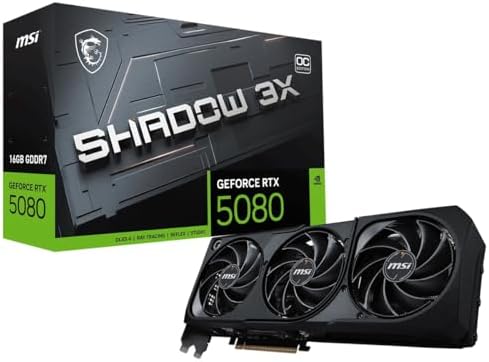
MSI's SHADOW 3X OC take on the RTX 5080, with 16GB of GDDR7, triple TORX fan cooling, and DLSS 4 multi-frame generation for sensibly-priced 4K builds.

In stock16GB GDDR7DLSS 4 with multi-frame genTriple TORX Fan 5.0ZERO FROZR 0 RPM256-bit memory bus
MSI GeForce RTX 5080 16G SHADOW 3X OC
16GB GDDR7DLSS 4 with multi-frame genTriple TORX Fan 5.0ZERO FROZR 0 RPM256-bit memory bus
Compare prices

Affiliate links, your price stays the same. How we check prices →

Our verdict

Excellent 4K with DLSS 4 multi-frame generation and capable triple-fan cooling, the value pick of MSI's 5080 range.

75/100
vs. other £1100 to £1500 current-gen 4K GPUs
Scored within its class as a current-gen high-end 4K Nvidia card, not against the RTX 5090 flagship or sub-£800 mid-range GPUs.
Best price found
£1,386
30-day low £1,150 · Average £1,237
See £1,386 deal at Amazon Uk

What we think

Swipe or tap to explore what we like, what to watch for, and who it's for

How it performs & what it pairs with

Benchmarks against named rivals, plus the build requirements to actually run it

Benchmarks
4K ultra settings, DLSS Quality where applicable
Cyberpunk 2077 (4K ultra, RT off)
MSI 5080 SHADOW 3X OC
116 fps avg
RTX 5090
156 fps avg
RTX 4080 SUPER
97 fps avg
Cyberpunk 2077 (4K ultra, RT ultra, DLSS Quality)
MSI 5080 SHADOW 3X OC
81 fps avg
RTX 5090
115 fps avg
RTX 4080 SUPER
62 fps avg
Alan Wake 2 (4K high, RT on, DLSS Quality)
MSI 5080 SHADOW 3X OC
85 fps avg
RTX 5090
112 fps avg
RTX 4080 SUPER
68 fps avg
Test bench

Tested with a Ryzen 7 9800X3D, 32GB DDR5-6000, Windows 11 24H2 on a 1000W PSU. Latest driver at time of testing.

Build compatibility
What your PC needs
Power supply
850W is the official recommendation and the realistic floor. With a high-end CPU, step up to 1000W for headroom against transient power spikes.
!
Case clearance
Full-size 303mm triple-fan card needs a roomy mid-tower with decent GPU length and slot clearance. Won't fit ITX or compact mATX builds.
Motherboard slot
PCIe 5.0 x16 slot, fully backward compatible with PCIe 4.0 boards. No noticeable performance difference at this card's bandwidth between PCIe versions.
!
12V-2x6 connector
Uses the updated 12V-2x6 power connector. Use a native cable from a modern ATX 3.0 or 3.1 PSU rather than an adapter, and seat it fully home without sharp bends.
CPU pairing
Pair with a Ryzen 7 9800X3D, Ryzen 9 7950X, Core i9 14900K or better. Older CPUs will bottleneck the card noticeably at 1440p and below.

Performance breakdown

Scored relative to the class, not against flagship models

vs. other £1100 to £1500 current-gen 4K GPUs
75/100
Best in class scored 96
Class average 82
Lowest in class 65
4K rasterisation92 / 100
Excellent native 4K performance, second only to RTX 5090
Ray tracing95 / 100
Outstanding RT thanks to 4th-gen cores and DLSS 4 multi-frame gen
Cooling and acoustics84 / 100
Capable triple TORX fan cooling with ZERO FROZR silent idle
Value for the chip88 / 100
Same 5080 performance as premium variants at lower pricing

Who this is right for

Picture yourself in these scenarios. How well does this fit?

Value-focused 4K gamer
Wants the 5080 chip at the lowest sensible MSI price. The SHADOW 3X OC delivers identical gaming performance to premium variants without paying for aesthetics.
Excellent fit
Single-player AAA enthusiast
Plays the latest big-budget releases at 4K with heavy ray tracing. DLSS 4 multi-frame generation makes even heavy path-traced titles smooth at high settings.
Excellent fit
Mid-tower 4K builder
Building in a roomy mid-tower with decent GPU clearance. The 303mm SHADOW fits comfortably and the triple-fan cooling keeps temperatures in check.
Good fit
Premium aesthetics buyer
Wants RGB lighting and premium build for a showpiece. The SHADOW's value tier build is simpler than Gaming Trio or SUPRIM variants. Those make more sense for showpiece builds.
Look elsewhere

What every spec actually means

Numbers translated into real-world impact

vram_gb16

Plenty for 4K gaming today, even with ray tracing and heavy texture packs enabled. Behind the 5090's 32GB for serious creator workloads, but ample for almost all gaming scenarios.

cuda_cores10752

Strong CUDA core count delivering excellent native 4K performance. Combined with DLSS 4 multi-frame generation, handles even heavy path-traced titles at 4K with upscaling.

memory_typeGDDR7

Latest memory generation at 30 Gbps, significantly faster than the GDDR6X used in the previous 4000 series. Helps with bandwidth-hungry scenarios at 4K.

memory_bus_bit256

Standard 5080 memory bus width. Combined with fast 30 Gbps GDDR7, delivers 960 GB/s of aggregate bandwidth comfortable even for 4K with the heaviest texture workloads.

length_mm303

Full-size triple-fan card. Needs a roomy mid-tower with decent GPU length and slot clearance. Won't fit ITX or compact mATX builds.

boost_clock_mhz2617

Factory-overclocked boost clock above reference 5080 specs. Real-world clocks under typical gaming load push slightly higher thanks to the capable triple TORX fan cooling.

Complete specifications

Verified across manufacturer datasheets and retailer spec tables

All specs
slots
2.5
2.5 to 4 slots typical, this is at 2.5
tdp w
360
300 to 400W class range, this is at 360
vram gb
16
12 to 32GB at this tier, this sits in the middle at 16
gpu chip
GB203
·
zero rpm
true
common at this tier, this has it
backplate
true
common at this tier, this has it
fan count
3
2 to 4 typical, this has 3
length mm
303
280 to 360mm typical, this is at 303
cuda cores
10752
·
hdmi count
1
1 to 2 typical, this has 1
pcie lanes
16
x16 standard at this tier
memory type
GDDR7
GDDR6X or GDDR7 in class, this is GDDR7
architecture
Blackwell
·
dlss version
4
DLSS 3 or 4 in class, this is at the top at DLSS 4
hdmi version
2.1
HDMI 2.1 standard across class
pcie version
PCIe 5.0
PCIe 5.0 standard at this tier
release year
2025
·
tensor cores
336
·
base clock mhz
2295
·
lithography nm
4
4nm or 5nm typical, this is 4nm
max resolution
4K
·
memory bus bit
256
256 to 512-bit at this tier, this is at 256-bit
boost clock mhz
2617
2500 to 2700 MHz typical, this is 2617
power connectors
16-pin
1x 12V-2x6 standard at this tier
displayport count
3
2 to 3 typical, this has 3
memory speed gbps
30
28 to 32 Gbps class range, this is 30
ray tracing cores
84
·
displayport version
2.1b
DP 2.1 standard at this tier, this is 2.1b
factory overclocked
true
common at this tier, this has it
psu recommendation w
850
850 to 1000W typical, this is 850
memory bandwidth gbps
960
900 to 1800 GB/s at this tier, this is 960
ray tracing generation
4th Gen
·

Common questions

The things people ask before buying this product

What's the difference between the MSI 5080 SHADOW and INSPIRE?

Both are MSI's value 5080 tier with capable triple-fan cooling and identical gaming performance. The INSPIRE is slightly more compact at 288mm versus the SHADOW's 303mm. Pick whichever is cheaper or fits your case.

Is the RTX 5080 worth buying over the RTX 5090?

Yes for most gamers. The 5080 delivers excellent 4K gaming with the same DLSS 4 features at roughly half the 5090's price. The 5090's extra performance is only justified for serious 4K maximalists or creators.

Will the MSI 5080 SHADOW 3X OC fit in my case?

At 303mm it's a full-size triple-fan card needing a roomy mid-tower with decent GPU clearance. Won't fit ITX or compact mATX builds. Check exact dimensions against your case before buying.

What PSU do I need for the MSI 5080 SHADOW 3X OC?

Nvidia recommends 850W for the 5080. With a power-hungry CPU like a Ryzen 9 or Core i9, step up to a quality 1000W unit for transient spike headroom against the 360W TDP.

Compare Electronic editors
Independent graphics cards comparison since 2025
Every product is scored against its own product class, not against flagship models. Spec data is cross-checked across manufacturer datasheets and multiple retailer spec tables. Prices are verified daily. We never rank by affiliate commission.
Read our methodology