Home/Compare/Graphics Cards/ASUS Prime GeForce RTX 5070
ASUS

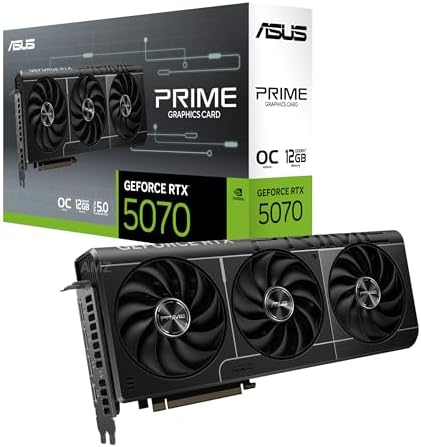
ASUS Prime GeForce RTX 5070

ASUS's Prime take on the current-gen RTX 5070, with 12GB of GDDR7, DLSS 4 multi-frame generation, and a compact 2.5-slot design for sensible 1440p builds.

In stock12GB GDDR7DLSS 4 with multi-frame genCompact 2.5-slotFactory overclockedPCIe 5.0
ASUS Prime GeForce RTX 5070
12GB GDDR7DLSS 4 with multi-frame genCompact 2.5-slotFactory overclockedPCIe 5.0Watch review
Compare prices

Affiliate links, your price stays the same. How we check prices →

Our verdict

A capable current-gen 1440p performer with DLSS 4 multi-frame generation and SFF-ready compact design, sensibly priced for the tier.

75/100
vs. other £550 to £750 1440p GPUs
Scored within its class as a current-gen mid-to-high range 1440p Nvidia card, not against flagship 4K-focused GPUs like the RTX 5080 or 5090.
Best price found
£560
30-day low £520 · Average £559
See £560 deal at Amazon Uk

What we think

Swipe or tap to explore what we like, what to watch for, and who it's for

How it performs & what it pairs with

Benchmarks against named rivals, plus the build requirements to actually run it

Benchmarks
1440p ultra settings, DLSS Quality where applicable
Cyberpunk 2077 (1440p ultra, RT off)
ASUS Prime RTX 5070
117 fps avg
RTX 5070 Ti
128 fps avg
RX 9070
107 fps avg
Cyberpunk 2077 (1440p ultra, RT ultra, DLSS Quality)
ASUS Prime RTX 5070
75 fps avg
RTX 5070 Ti
84 fps avg
RX 9070
65 fps avg
Alan Wake 2 (4K high, RT on, DLSS Quality)
ASUS Prime RTX 5070
57 fps avg
RTX 5070 Ti
68 fps avg
RX 9070
61 fps avg
Test bench

Tested with a Ryzen 7 9800X3D, 32GB DDR5-6000, Windows 11 24H2 on an 850W PSU. OC mode BIOS, latest driver at time of testing.

Build compatibility
What your PC needs
Power supply
650W is the official recommendation. Most existing builds will run it on their current PSU without needing to upgrade.
Case clearance
Compact 2.5-slot Prime design fits virtually any mid-tower, mATX, and most ITX cases. Genuinely SFF-friendly at this performance tier.
Motherboard slot
PCIe 5.0 x16 slot, fully backward compatible with PCIe 4.0 boards. No noticeable performance difference at this card's bandwidth between PCIe versions.
!
12V-2x6 connector
Uses the updated 12V-2x6 power connector. Use a native cable from a modern ATX 3.0 or 3.1 PSU rather than an adapter, and seat it fully home without sharp bends.
CPU pairing
Pair with a Ryzen 7 7800X3D, Ryzen 9 7950X, Core i7 14700K or better. Older CPUs will bottleneck the card noticeably at 1440p and below.

Performance breakdown

Scored relative to the class, not against flagship models

vs. other £550 to £750 1440p GPUs
75/100
Best in class scored 90
Class average 76
Lowest in class 60
1440p rasterisation84 / 100
Strong 1440p performance, solidly in the current-gen high-tier
4K rasterisation70 / 100
Capable with DLSS, narrow bus limits native 4K headroom
Ray tracing86 / 100
Excellent RT thanks to 4th-gen cores and DLSS 4 multi-frame gen
Form factor90 / 100
Compact 2.5-slot SFF-friendly design, rare at this performance tier

Watch it in action

Powered byYouTube

Who this is right for

Picture yourself in these scenarios. How well does this fit?

Compact build 1440p gamer
Building or upgrading a mid-tower, mATX, or ITX PC at 1440p. The compact 2.5-slot Prime design fits where bulkier partner cards won't, with full 5070 performance intact.
Excellent fit
1440p high-refresh gamer
Driving a 1440p 144Hz or 240Hz monitor and chasing every frame with maxed settings. The 5070 with DLSS 4 multi-frame generation hits this sweet spot well.
Excellent fit
Entry 4K gamer
Plays at 4K mostly with DLSS Quality enabled. Capable in most titles thanks to multi-frame gen, though the 12GB VRAM pushes harder than the 5070 Ti's 16GB in newest releases.
Good fit
Native 4K maximalist
Wants to play at native 4K ultra without upscaling. The 5070 doesn't have the VRAM or bandwidth for that consistently. RTX 5080 or higher is the right pick.
Look elsewhere

What every spec actually means

Numbers translated into real-world impact

vram_gb12

Adequate for 1440p today but tightening at 4K ultra in new releases. Behind the 16GB 5070 Ti in long-term headroom, but enough for the 5070's typical resolution target.

tdp_w250

Modest power draw for the performance on offer. The 650W PSU recommendation is realistic, and most existing builds will run it on their current power supply without trouble.

memory_typeGDDR7

Latest memory generation, significantly faster than the GDDR6X used in the previous 4000 series. Helps with bandwidth-hungry scenarios and high-resolution texture loads.

dlss_version4

Supports the latest Nvidia upscaling and frame generation stack, including multi-frame generation exclusive to the 50 series. Biggest reason to choose Blackwell at this tier.

slots2.5

Compact 2.5-slot design fits in mid-tower, mATX, and most ITX cases. Genuinely SFF-friendly at this performance tier, rare and useful for compact builds.

memory_bandwidth_gbps672

High bandwidth thanks to fast GDDR7 memory. Comfortable for 1440p gaming, though the narrower bus limits 4K headroom compared to wider-bus cards like the 5070 Ti and 5080.

Complete specifications

Verified across manufacturer datasheets and retailer spec tables

All specs
slots
2.5
2 to 3.5 slots typical, this is compact at 2.5
tdp w
250
200 to 300W class range, this is mid at 250
ai tops
988
·
vram gb
12
12 to 16GB typical, this is at the low end at 12
gpu chip
GB205
·
zero rpm
true
·
dual bios
true
·
cuda cores
6144
·
hdmi count
1
1 to 2 typical, this has 1
memory type
GDDR7
GDDR6X or GDDR7 in class, this is GDDR7
architecture
Blackwell
·
dlss version
4
DLSS 3 or 4 in class, this is DLSS 4
hdmi version
2.1
HDMI 2.1 standard across class
pcie version
5.0
PCIe 4.0 or 5.0 in class, this is 5.0
release year
2025
·
tensor cores
192
·
base clock mhz
2152
·
lithography nm
4
4nm or 5nm typical, this is 4nm
memory bus bit
192
192 to 256-bit typical, this is narrow at 192-bit
boost clock mhz
2512
2400 to 2700 MHz typical, this is 2512
power connectors
1x 16-pin
12VHPWR or 12V-2x6 standard at this tier
displayport count
3
2 to 3 typical, this has 3
memory speed gbps
28
20 to 30 Gbps class range, this is 28
ray tracing cores
48
·
displayport version
2.1b
DP 1.4a or 2.1 in class, this is 2.1b
factory overclocked
true
·
psu recommendation w
650
550 to 750W typical, this is 650
memory bandwidth gbps
672
440 to 1000 GB/s class range, this is 672
ray tracing generation
4th Gen
3rd or 4th gen, this is 4th Gen

Common questions

The things people ask before buying this product

Is the Prime 5070 worth buying over the 5070 Ti?

If budgets are tight or compact form matters, yes. The Prime 5070 hits 1440p high-refresh well at a noticeably lower price than the 5070 Ti. For 4K-focused or future-proofing buyers, the Ti's 16GB VRAM is the smarter pick.

How does the Prime 5070 compare to the RX 9070?

Nvidia wins on ray tracing and DLSS 4 multi-frame gen. AMD often wins on raw rasterisation value. Pick based on whether you prioritise RT and upscaling features or raw raster fps per pound.

Will the Prime 5070 fit in an ITX case?

Likely yes. The compact 2.5-slot design is genuinely SFF-friendly, fitting most modern ITX cases that accept dual-slot or 2.5-slot GPUs. Check exact dimensions against your specific case before buying.

What PSU do I need for the RTX 5070?

Nvidia recommends 650W. With a power-hungry CPU like a Core i9 or Ryzen 9, step up to a quality 750W or 850W unit. Don't try to scrape by with a 550W PSU at this performance tier.

Compare Electronic editors
Independent graphics cards comparison since 2025
Every product is scored against its own product class, not against flagship models. Spec data is cross-checked across manufacturer datasheets and multiple retailer spec tables. Prices are verified daily. We never rank by affiliate commission.
Read our methodology