Home/Compare/CPUs/Intel Core i7-14700K
Intel

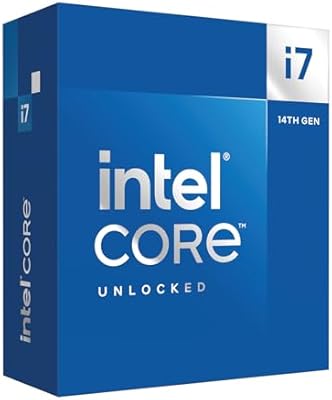
Intel Core i7-14700K

Intel's unlocked 14th-gen 20-core with integrated UHD 770 graphics, a 5.6 GHz ceiling, and full OC access for gaming and productivity builds on LGA1700.

In stock20 cores / 28 threads5.6 GHz boostIntel UHD 770 iGPUUnlocked multiplierLGA1700 socket
Intel Core i7-14700K
20 cores / 28 threads5.6 GHz boostIntel UHD 770 iGPUUnlocked multiplierLGA1700 socketWatch review
Compare prices

Affiliate links, your price stays the same. How we check prices →

Our verdict

Intel's 14th-gen 20-core K with integrated graphics, a 5.6 GHz ceiling and full OC access below the i9 in price and power.

86/100
vs. other high-end LGA1700 K-series gaming and productivity CPUs
Scored within its class as a high-end LGA1700 gaming and productivity CPU, not against the flagship i9 or AMD AM5 chips.
Best price found
£350
30-day low £325 · Average £336
See £350 deal at Amazon Uk

What we think

Swipe or tap to explore what we like, what to watch for, and who it's for

How it performs & what it pairs with

Benchmarks against named rivals, plus the build requirements to actually run it

Benchmarks
Stock power limits, RTX 5080, DDR5-6000, Z790 board
Counter-Strike 2 (1080p competitive)
Core i7-14700K
436 fps avg
Core i9-14900K
492 fps avg
Ryzen 7 9800X3D
562 fps avg
Cinebench R23 multi-core
Core i7-14700K
33800 pts
Core i9-14900K
40200 pts
Core i7-13700K
30800 pts
Cyberpunk 2077 (1440p ultra, RT off)
Core i7-14700K
128 fps avg
Core i9-14900K
140 fps avg
Ryzen 7 9800X3D
145 fps avg
Test bench

Tested with RTX 5080, 32GB DDR5-6000, Z790 board, Windows 11 24H2. Default Intel power limits, latest microcode applied.

Build compatibility
What your PC needs
LGA1700 socket
Fits Intel 700 and 600 series boards. Z690 or Z790 for overclocking.
!
360mm AIO or large tower needed
Up to 253W under all-core sustained load. Don't undersize the cooler.
DDR4 or DDR5
Board determines memory type. DDR4 significantly lowers total build cost.
Intel UHD 770 iGPU
Integrated graphics for display output and system setup.
!
Apply latest microcode
Update board BIOS for 14th gen microcode before sustained workloads.

Performance breakdown

Scored relative to the class, not against flagship models

vs. other high-end LGA1700 K-series gaming and productivity CPUs
86/100
Best in class scored 96
Class average 76
Lowest in class 52
Gaming performance84 / 100
5.6 GHz ceiling strong, AMD V-Cache still leads
Multi-threaded performance88 / 100
20 hybrid cores with 28 threads scale well
Single-threaded performance90 / 100
5.6 GHz Raptor Lake Refresh competitive
Overclocking headroom78 / 100
Unlocked on Z690/Z790 boards

Watch it in action

Powered byYouTube

Who this is right for

Picture yourself in these scenarios. How well does this fit?

LGA1700 K-chip gaming and productivity builder
Wants unlocked 20-core 14th gen with iGPU fallback and OC access. The 14700K covers all three without i9 pricing.
Excellent fit
Heavy gaming and streaming setup
Runs OBS alongside gaming. 20 hybrid cores and 28 threads handle simultaneous gaming and encoding comfortably, better than 16-core 13th gen chips.
Good fit
LGA1700 upgrader from 12th gen
On a Z690 or Z790 board and wants the best value-for-performance K-chip for an upgrade. The 14700K's extra E-cores over the 13700K are a step up within the platform.
Good fit
Fresh build buyer wanting future upgrades
LGA1700 is end of life. For a fresh build planning upgrades, AM5 or LGA1851 are better platform choices.
Look elsewhere

What every spec actually means

Numbers translated into real-world impact

boost_clock_ghz5.6 GHz

5.6 GHz via Turbo Boost Max 3.0 is competitive for gaming and single-threaded tasks. Just 0.4 GHz below the i9-14900K's ceiling, with only small real-world gaming difference.

core_count20

Eight P-cores and twelve E-cores with 28 threads total via HyperThreading. Four more E-cores than the 13700K for better background task handling.

max_power_w253W

Peak all-core power under sustained workloads. Gaming stays well below this, but rendering and compilation approach the limit. A quality 360mm AIO or large tower is strongly recommended.

codenameRaptor Lake Refresh

Refined 13th gen Raptor Lake architecture with higher clocks. Minor generational improvement over 13th gen chips at the same core configuration.

integrated_graphicstrue

Intel UHD Graphics 770 handles display output for system setup, troubleshooting, and lightweight use without a discrete GPU.

Complete specifications

Verified across manufacturer datasheets and retailer spec tables

All specs
aes
true
hardware AES standard on 14th gen
avx
AVX2
AVX2 standard
smt
true
HyperThreading on P-cores, single thread on E-cores
tdp w
125
125W base, up to 253W under all-core sustained load
family
Core i7
·
socket
FCLGA1700
FCLGA1700, end-of-life platform
chipset
Intel 700 Series and Intel 600 Series
Intel 700 and 600 series boards; Z-series for OC
e cores
12
12 Efficiency cores for background and light tasks
p cores
8
8 Performance cores with HyperThreading up to 5.6 GHz
codename
Raptor Lake Refresh
Raptor Lake Refresh, minor refinement of 13th gen Raptor Lake
core count
20
20 hybrid cores, i7-tier on LGA1700
generation
14th Gen
14th Gen Raptor Lake Refresh
igpu model
Intel UHD Graphics 770
Intel UHD Graphics 770, display fallback and setup
max temp c
100
100°C junction max
pcie lanes
20
20 PCIe lanes
ecc support
true
ECC supported
l2 cache mb
28
28MB L2 across 20 cores
l3 cache mb
33
33MB L3
max power w
253
253W peak; serious cooling required for sustained all-core
memory type
DDR5, DDR4
DDR4 or DDR5, board dependent
x64 support
true
·
manufacturer
Intel
·
pcie version
5
PCIe 5.0 on 700-series boards
release date
Q4'23
Q4 2023, available at reduced LGA1700 pricing
thread count
28
28 threads from 20 cores via HyperThreading on P-cores
max memory gb
192
192GB max
base clock ghz
3.4
3.4 GHz base
igpu clock mhz
300
300 MHz base iGPU
igpu turbo mhz
1600
1600 MHz iGPU turbo, display fallback only
lithography nm
10
Intel 10nm Enhanced SuperFin
market segment
Desktop
·
virtualization
true
Intel VT-x supported
boost clock ghz
5.6
5.6 GHz Turbo Boost Max 3.0
memory channels
2
2-channel DDR4 or DDR5
integrated graphics
true
Intel UHD 770 on-die
unlocked multiplier
true
fully unlocked on Z690 and Z790 boards
memory speed max mhz
5600
5600 MHz DDR5 official

Common questions

The things people ask before buying this product

What is the difference between the i7-14700K and i7-13700K?

The 14700K adds four more E-cores (12 versus 8) and a marginally higher 5.6 GHz boost versus 5.4 GHz on the 13700K. At similar used prices, the extra E-cores benefit multi-threaded workloads modestly.

Does the i7-14700K include a cooler?

No. A quality 360mm AIO or large tower cooler is needed, particularly for sustained all-core workloads approaching 253W.

Is there a meaningful difference between the 14700K and 14700 (non-K)?

The K has an unlocked multiplier and a higher boost clock ceiling. The non-K has a lower 65W base TDP and includes the Laminar RM1 cooler. For no-OC builds, the non-K's lower thermal demands are genuinely useful.

Should I buy the i7-14700K or try Arrow Lake?

For gaming-only builds, neither leads AMD V-Cache. For LGA1700 upgrades, the 14700K is a strong pick. For fresh builds wanting a platform future, Arrow Lake on LGA1851 is the Intel direction.

Compare Electronic editors
Independent cpus comparison since 2025
Every product is scored against its own product class, not against flagship models. Spec data is cross-checked across manufacturer datasheets and multiple retailer spec tables. Prices are verified daily. We never rank by affiliate commission.
Read our methodology